
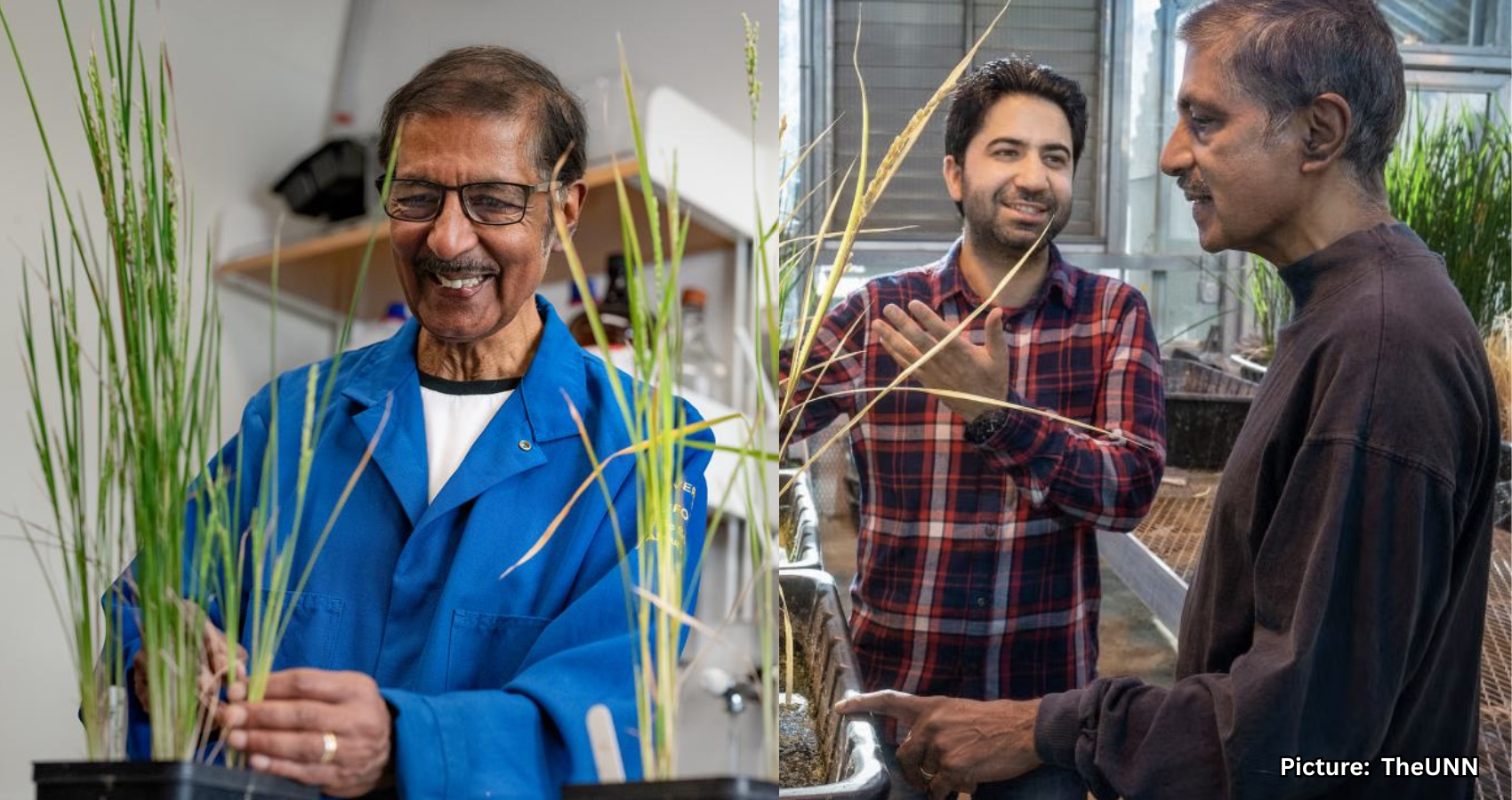
Two Indian American plant biologists have been awarded the $500,000 VinFuture Prize for their groundbreaking work in developing self-cloning crops, a significant advancement for sustainable agriculture.
Two Indian American researchers from the University of California, Davis, have been honored with the prestigious VinFuture Prize for their innovative work in developing self-cloning crops, which represents a major breakthrough in sustainable agriculture.
Venkatesan Sundaresan, a Distinguished Professor of Plant Biology and Plant Sciences, and Imtiyaz Khanday, an Assistant Professor of Plant Sciences, traveled to Hanoi, Vietnam, to accept the award during a special ceremony held by the VinFuture Foundation on December 5.
The VinFuture Special Prize for Innovators with Outstanding Achievements in Emerging Fields, established in 2021, recognizes groundbreaking research and innovations that have the potential to create positive changes for humanity. The award includes a monetary prize of $500,000.
Khanday expressed his gratitude for the recognition, stating, “I’m honored that the global impact of our research is being recognized in this way. I come from a farming family, and I’ve always wanted to develop technologies that help farmers, especially smallholder farmers. We’re trying to make better seeds for the world.”
As global temperatures rise and the human population continues to grow, creating sustainable agricultural systems has become increasingly urgent. One effective method to enhance crop yields is through the use of hybrid crops, which are produced by crossing two genetically distinct varieties. These hybrids can yield up to 50% more grain than their parent plants. However, the offspring of these hybrids often exhibit unpredictable yields, forcing farmers to purchase new seeds annually to maintain the benefits of hybridization.
Sundaresan and Khanday’s research has led to the development of hybrid crops that can clone themselves, thereby ensuring that their high yields can be sustained across generations. This innovative approach could significantly benefit millions of rice farmers and billions of people in developing countries who rely on rice as a primary food source.
<p“Making crop hybrids widely available to smallholder farmers can meet food demands for the 21st century sustainably, without increasing land use or agricultural inputs,” Sundaresan noted.
The process of creating self-cloning plants involves two critical steps. First, the researchers employed CRISPR/Cas-9 technology to deactivate genes associated with meiosis, ensuring that the plant’s egg cells contain a complete set of chromosomes. Next, they activated a gene known as BBM1, which prompts the egg cells to develop into embryos without requiring fertilization.
This method mimics a natural process called apomixis, which occurs in various plant species, including blackberries and oranges. The resulting embryos possess identical genetic material to their parents, allowing farmers to save seeds for future planting.
The team’s groundbreaking innovation emerged from fundamental research supported by federal grants, illustrating how scientific discoveries and their impactful applications can often arise unexpectedly. “When we started out, we weren’t even working on this problem,” Sundaresan recalled. “We were just trying to understand how plants make embryos.”
Khanday discovered the role of BBM1 in embryo activation while serving as a postdoctoral fellow in Sundaresan’s lab. Concurrently, researchers Raphael Mercier from the Max Planck Institute for Plant Breeding Research in Germany, along with Emmanuel Guiderdoni and Delphine Mieulet from CIRAD in France, developed a method to prevent meiosis in rice. The collaboration between these groups ultimately led to the creation of synthetic apomixis.
The team first unveiled their self-cloning technique in rice in 2018. Since then, they have identified an additional gene that boosts the success rate of this method to approximately 90%. They have also demonstrated the feasibility of synthetic apomixis in maize, and an independent research group has recently applied their method to induce apomixis in sorghum.
Currently, Sundaresan and Khanday are working to expand the applications of self-cloning hybrids. While Sundaresan focuses on optimizing the technology for rice and other cereal crops, Khanday is developing self-cloning vegetable crops, beginning with potatoes and tomatoes.
<p“You can preserve any desirable genotype with this technology, whether that’s disease resistance or climate tolerance,” Khanday explained. “Synthetic apomixis has the potential to impact agriculture globally, especially for smallholder farmers.”
Sundaresan and Khanday share the VinFuture Prize with their collaborators Mercier, Guiderdoni, and Mieulet. “We are poised on what I hope will be a new revolution in agriculture,” Sundaresan stated. “Our invention means that the benefits of hybrid crops will become available, equitable, and accessible to farmers all over the world. This is hugely important for achieving sustainable food production.”
According to The American Bazaar, the recognition of their work underscores the importance of innovative agricultural practices in addressing global food security challenges.