
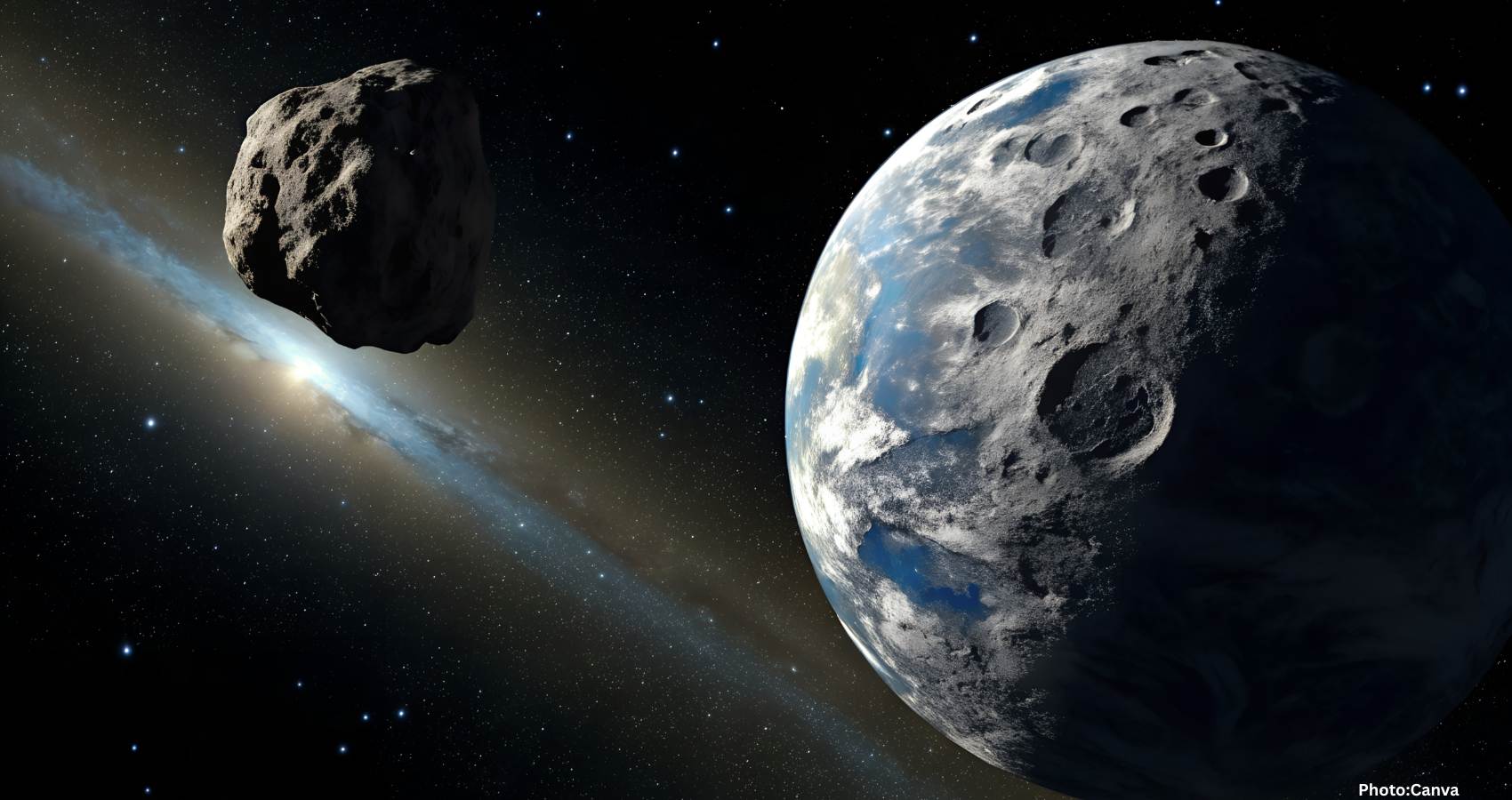
Earth is set to bid farewell to a “mini moon” asteroid, which will return for a brief visit in 2055 after its departure on Monday.
Earth is preparing to part ways with an asteroid that has been accompanying it as a “mini moon” for the past two months. This harmless space rock, designated 2024 PT5, will drift away on Monday, influenced by the stronger gravitational pull of the sun. However, it is expected to return for a brief visit in January.
Nasa plans to utilize a radar antenna to observe the 33-foot asteroid during its January visit, which will enhance scientists’ understanding of this intriguing object. Researchers believe that 2024 PT5 may be a fragment blasted off the moon by an asteroid impact that created a crater.
Although it is not technically classified as a moon—NASA emphasizes that it was never captured by Earth’s gravity—it is considered “an interesting object” worthy of further study. The asteroid was identified by astrophysicist brothers Raul and Carlos de la Fuente Marcos from Complutense University of Madrid, who have conducted hundreds of observations in collaboration with telescopes located in the Canary Islands.
Currently, 2024 PT5 is more than 2 million miles away from Earth, making it too small and faint to be seen without a powerful telescope. In January, it will pass within approximately 1.1 million miles of Earth, maintaining a safe distance before continuing its journey through the solar system. The asteroid is not expected to return until 2055, when it will be nearly five times farther from Earth than the moon.
First detected in August, the asteroid began its semi-orbit around Earth in late September after being influenced by Earth’s gravity, following a horseshoe-shaped trajectory. By the time it makes its return next year, it will be traveling at more than double its speed from September, making it unlikely to linger, according to Raul de la Fuente Marcos.
Nasa will track 2024 PT5 for over a week in January using the Goldstone solar system radar antenna, located in California’s Mojave Desert, as part of the Deep Space Network. Current data indicates that during its 2055 visit, the sun-orbiting asteroid will once again make a temporary and partial lap around Earth.
Source: Original article