
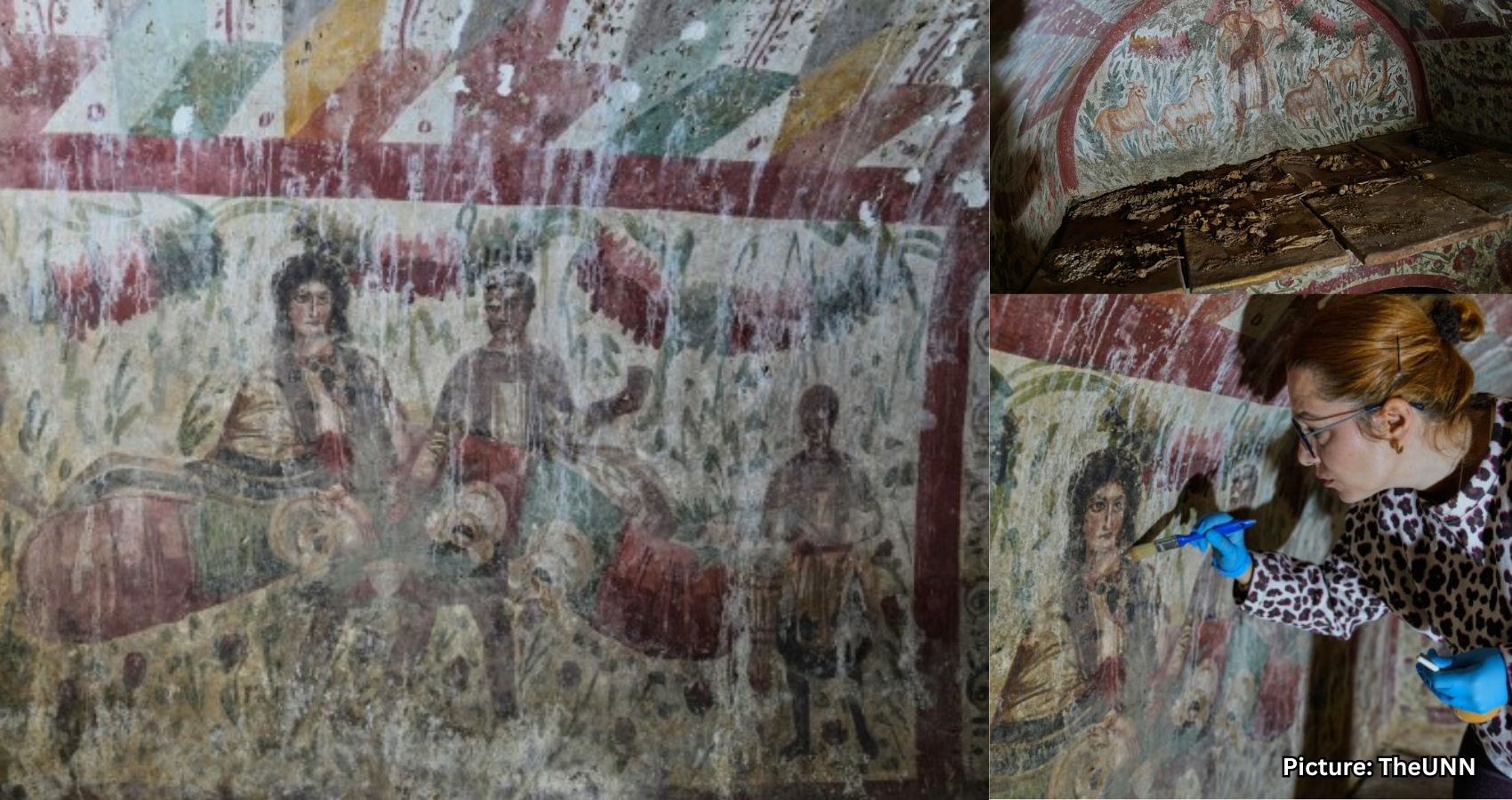
Archaeologists in Turkey have uncovered a rare fresco of Jesus, depicting him as the “Good Shepherd,” in an underground tomb dating back to the third century.
In a remarkable archaeological discovery, researchers in Turkey have unearthed a fresco depicting a Roman-looking Jesus as the “Good Shepherd.” This significant find, hailed as one of the most important from Anatolia’s early Christian era, was made in August within an underground tomb near the town of Iznik.
Iznik is historically notable as the site where the Nicene Creed, a foundational statement of Christian belief, was adopted in A.D. 325. The tomb itself is believed to date back to the third century, a time when Christians faced persecution under the Roman Empire.
The fresco portrays a youthful, clean-shaven Jesus dressed in a toga and carrying a goat on his shoulders. According to The Associated Press, which was the first international media organization granted access to the tomb, this artwork is one of the rare instances in Anatolia where Jesus is depicted with Roman attributes.
The lead archaeologist on the project has suggested that this fresco could be the “only example of its kind in Anatolia,” underscoring its significance in the study of early Christian art.
Coinciding with this discovery, Pope Leo XIV recently visited Iznik as part of his first overseas trip since becoming the head of the Vatican. During his visit, he marked the 1,700th anniversary of the Council of Nicaea, which established the Nicene Creed that continues to be recited by millions of Christians today.
During the visit, Turkish President Recep Tayyip Erdoğan presented the pope with a tile painting of the “Good Shepherd” fresco, further highlighting the importance of this archaeological find.
While in Turkey, Pope Leo XIV was accompanied by Eastern and Western patriarchs and priests. Together, they prayed for the unity of Christians, gathering at the site where the Council of Nicaea convened. The group recited the Nicene Creed, which the pope described as “of fundamental importance in the journey that Christians are making toward full communion.”
This discovery not only sheds light on the artistic expressions of early Christianity but also coincides with significant moments in contemporary Christian history, making it a focal point for both scholars and believers alike.
According to The Associated Press, the fresco’s discovery is a testament to the rich heritage of early Christian art and its enduring legacy in the region.