
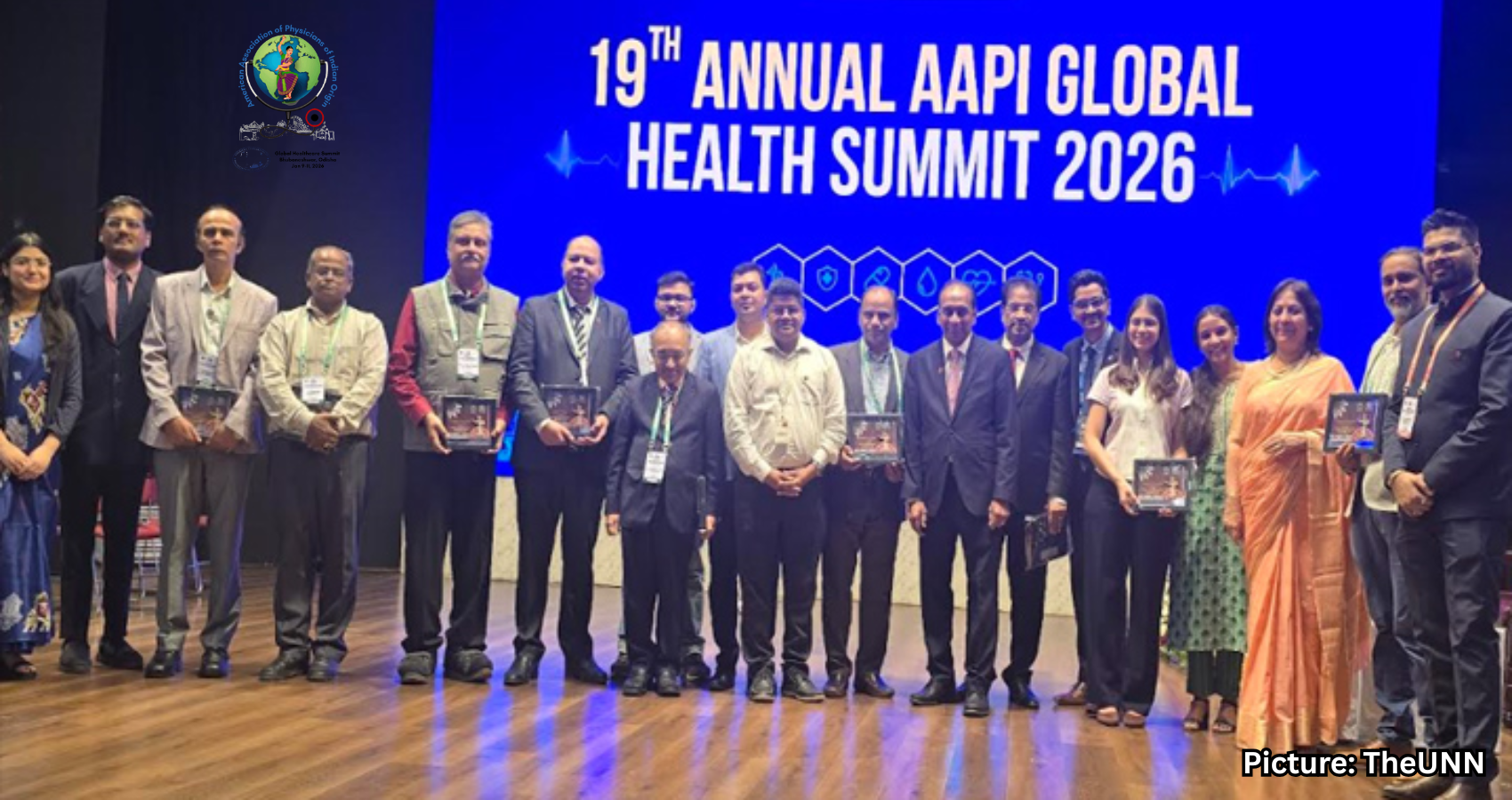
The AAPI Global Health Summit 2026 in Odisha highlighted innovative emergency care training, including mass CPR sessions and AI-driven clinical education, aimed at enhancing India’s emergency medical response.
The American Association of Physicians of Indian Origin (AAPI) is advancing its mission to strengthen global emergency care through innovation, technology, and Indo-U.S. collaboration. A landmark Resuscitation and Emergency Medical Care Workshop was held on January 10, 2026, at the Kalinga Institute of Medical Sciences (KIMS) in Odisha.
This workshop, a signature component of the AAPI Global Health Summit (GHS) 2026, featured mass CPR training on January 9 and high-fidelity simulation alongside AI-enabled multi-specialty clinical case discussions on January 10. These sessions set a new national benchmark for emergency medicine education.
AAPI President Dr. Amit Chakrabarty described the summit as a defining moment for Indo-U.S. medical collaboration. “GHS 2026 reflects AAPI’s unwavering commitment to elevating global health standards,” he stated. “When experts from two of the world’s most dynamic healthcare systems come together, the impact extends far beyond conference halls—it reaches communities, hospitals, and future generations.”
The day began with an ambitious AAPI Mass CPR Training Event for college students, coordinated by Dr. Dillip Panda, Director of KIMS, and Dr. Sathya Swaroop Patnaik of the Sri Sathya Sai Seva Organizations, Odisha. Under the guidance of Dr. Vemuri S. Murthy, a globally recognized Indo-U.S. resuscitation expert and Coordinator of the GHS CME programs, the session trained approximately 1,000 college students in accordance with the latest Resuscitation Guidelines, emphasizing high-quality CPR, early defibrillation, and post-cardiac arrest care.
Dr. Murthy highlighted the importance of early training, stating, “The future of global medical practice lies in the hands of the younger generation—medical students and residents—who have a unique opportunity to integrate cutting-edge technologies such as simulation and AI with traditional clinical evaluation.”
Later in the day, the workshop featured a series of high-impact expert presentations. Dr. Joginder Solanki, representing the American Heart Association, outlined the updated 2025 resuscitation guidelines. Dr. Srinivas Ramaka, a distinguished cardiac arrest research expert in India, delivered a data-rich session on the epidemiology of out-of-hospital cardiac arrest (OHCA) in India, emphasizing the urgent need for public CPR training, improved access to automated external defibrillators (AEDs), and structured emergency response systems.
Dr. Debasish Swain, a faculty member of the National Emergency Life Support (NELS) Program in Odisha, presented the Government of India’s ambitious NELS Program. This mandatory five-day emergency care training initiative for all medical graduates integrates Basic Life Support (BLS), Advanced Cardiac Life Support (ACLS), and Advanced Trauma Life Support (ATLS), with a strong emphasis on hands-on learning.
The simulation and AI-based clinical case discussion workshop featured a distinguished panel of Indo-U.S. faculty, bringing together respected leaders in resuscitation science, emergency medicine, cardiology, and critical care. The expert team, led by Dr. Vemuri Murthy and Dr. Atasu Nayak, Co-Chair of the Workshop, included Dr. Anjali Gulati, Dr. Srinivas Ramaka, Dr. Ashok Kumar Badamali, Dr. Suresh Karne, Dr. Lt. Col. Y. Ashok, Dr. Abanibhusan Jena, Dr. Basanta Mohapatra, Dr. Arun Panigrahi, and Dr. Abhishek Kashyap.
Their combined expertise, spanning cardiology, anesthesiology, critical care, emergency life support, and advanced simulation training, added exceptional depth and credibility to the program, reinforcing the workshop’s status as one of the most comprehensive and high-impact sessions of the summit.
A major highlight of the workshop was the hands-on simulation training featuring the SimMan 3G Plus, an advanced high-fidelity simulation platform provided by Laerdal India. Participants practiced real-time decision-making in complex emergency scenarios, bridging the gap between theoretical knowledge and clinical readiness.
The session also included an AI-based multi-specialty clinical case discussion, showcasing the growing role of artificial intelligence in diagnostic reasoning, triage, and emergency decision support. Dr. Murthy emphasized the significance of these innovations, stating, “Simulation and AI are no longer optional—they are essential tools for improving survival outcomes and elevating the standard of emergency care worldwide.”
The workshop took place against the backdrop of India’s disproportionate burden of cardiovascular disease and trauma. India accounts for 60% of global heart disease patients, and nearly 20 million annual deaths worldwide are attributed to heart-related disorders. Alarmingly, half of all heart attacks in Indians occur before the age of 50, while India records 1.6 million strokes annually, with one-third resulting in disability. Additionally, the country has one of the highest global rates of trauma and head injury, largely due to road accidents.
AAPI has long championed initiatives to address these challenges. Dr. Meher Medavaram, AAPI President-Elect, highlighted the organization’s commitment: “AAPI has been at the forefront of collaborating with Indo-U.S. organizations and training hundreds of first responders at Global Health Summits. These efforts will save lives and strengthen India’s emergency response capacity.”
These trainings equip police, traffic personnel, and paramedics with essential lifesaving skills, significantly improving survival chances in trauma and cardiac emergencies.
The Resuscitation and Emergency Medical Care Workshop was part of a larger summit that showcased groundbreaking advances in clinical practice and medical technology. GHS 2026 featured live robotic and minimally invasive surgeries broadcast between KIMS and Swosti Premium, as well as scientific sessions on metabolic syndrome, hemoglobinopathies, cervical cancer prevention, PSA screening, carotid stenosis, and joint preservation. The summit also facilitated cross-border collaboration between leading Indian and U.S. physicians.
Dr. Amit Chakrabarty remarked, “The integration of advanced technology and international expertise is shaping a new era in Indian healthcare. Odisha is emerging as a hub for clinical excellence and innovation.”
The Resuscitation and Emergency Medical Care Workshop at GHS 2026 reaffirmed AAPI’s leadership in strengthening India’s emergency response infrastructure, promoting Indo-U.S. collaboration in medical education, leveraging simulation and AI to elevate clinical training, and empowering students, residents, and first responders with lifesaving skills.
By uniting innovation, expertise, and a commitment to public health, AAPI continues to drive transformative change, advancing its mission to improve global health outcomes and positioning Odisha as a rising center of excellence in emergency medicine.
For more information on AAPI and its global initiatives, please visit www.appiusa.org.