
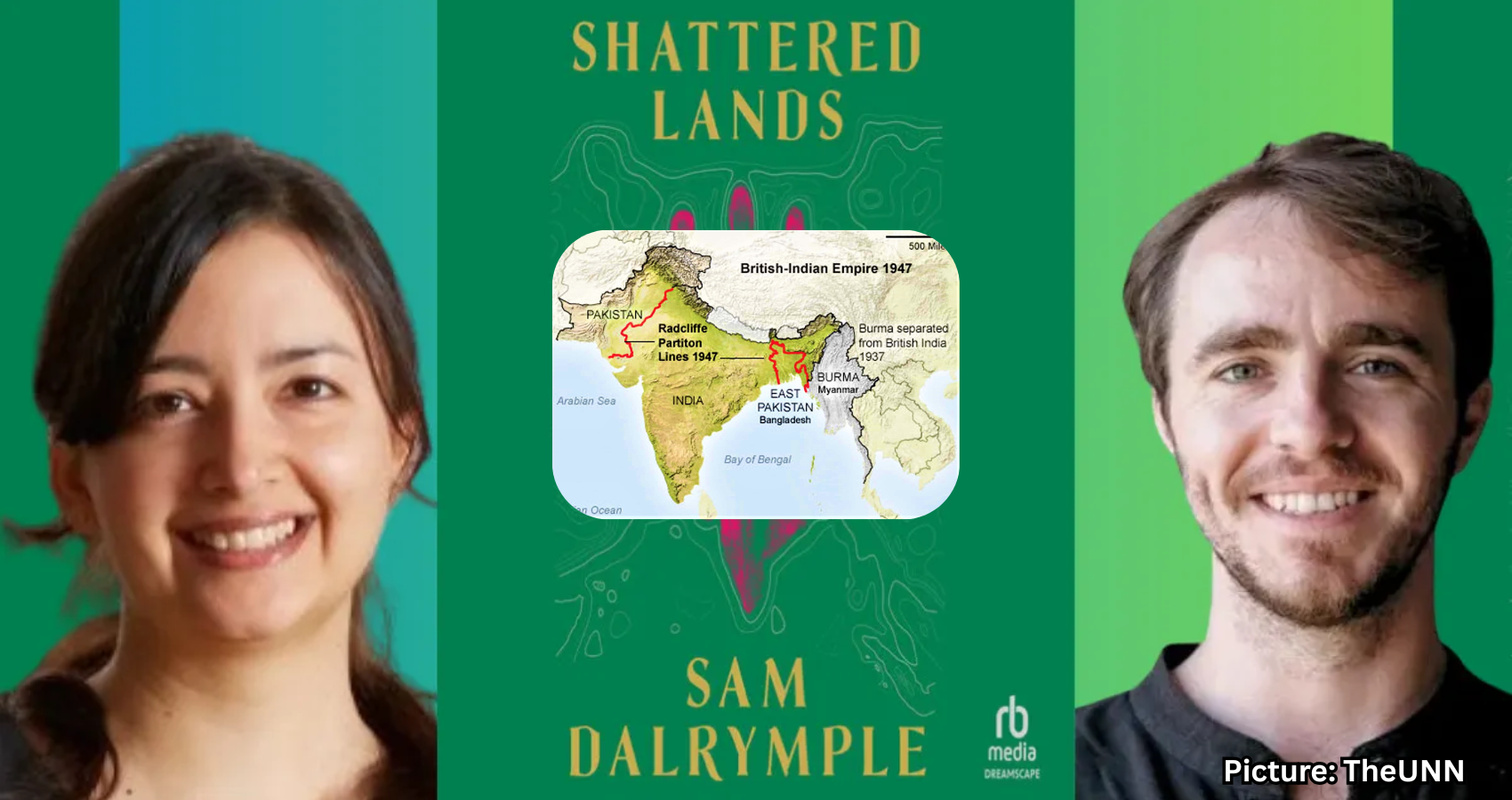
Sam Dalrymple discusses the complexities of the British Raj’s partitions and their enduring impact on contemporary geopolitics in a conversation with Guneeta Singh Bhalla.
On March 13, Sam Dalrymple, author of the book *Shattered Lands*, engaged in a thought-provoking discussion with Guneeta Singh Bhalla, founder of the 1947 Partition Archive, at their Berkeley headquarters. Their conversation delved into the origins of Dalrymple’s debut novel and examined how the partitions of the British Raj have shaped the geopolitical landscape of the post-colonial world.
At just 29 years old, Dalrymple grew up in Delhi, a city deeply influenced by the 1947 Partition, where nearly every resident carries a migration story in their family history. The dialogue quickly transitioned from personal narratives to broader geopolitical themes as Dalrymple recounted his surreal experience crossing the border into Lahore. He described Lahore as a “twin city” that mirrors Delhi in both social and architectural aspects, yet remains tragically inaccessible to many.
This shared history of displacement, coupled with the irony of encountering South Asian peers at Oxford, inspired Dalrymple’s involvement with Project Dastaan. This initiative aims to reconnect aging survivors with the homes and memories they left behind seventy-five years ago. His book, *Shattered Lands*, emerged from the extensive research conducted for this project.
Dalrymple argues that *Shattered Lands* reveals lesser-known truths about the partitions of the British Raj. He points out that between 1926 and 1976, five significant partitions fragmented the once-unified imperial space, ultimately giving rise to twelve nation-states. These divisions reshaped political borders and identities, leaving lasting impacts that continue to influence contemporary conflicts in regions such as Kashmir, Balochistan, Myanmar, Yemen, and even the Gulf War.
According to Dalrymple, these historical ruptures are often overlooked in popular narratives, which tend to focus narrowly on the 1947 Partition. He emphasizes that understanding the relationships among key leaders is crucial to comprehending the political decisions that led to these divisions.
Dalrymple asserts that one cannot separate a leader’s private life from their public decisions, as the two are irrevocably intertwined. He cites Muhammad Ali Jinnah as a pivotal example, explaining that Jinnah’s shift toward advocating for a separate Pakistan was deeply influenced by personal heartbreak. Initially a modern, secular figure who believed in Hindu-Muslim unity, Jinnah’s perspective changed dramatically following the social rejection of his interfaith marriage and the tragic death of his wife. Political betrayals further fueled his transformation, particularly when Nehru and Gandhi took advantage of Jinnah’s absence during his wife’s hospitalization to pass resolutions against Muslim reservations—an act Jinnah never forgave.
Dalrymple contends that the Partition was not the result of mass movements but rather the decisions made by a small group of influential men: Jinnah, Nehru, Gandhi, Mountbatten, Sardar Patel, Liaquat Ali Khan, and Cyril Radcliffe. He argues that their relationships ultimately determined the fate of one-quarter of the world’s population.
In crafting his narrative, Dalrymple drew on diverse sources, including the 1947 Partition Archive curated by Bhalla, to combine traditional research with approximately 80 to 100 multilingual interviews. By centering these personal narratives in his work, he highlights lived experiences that are often overlooked or erased by official state records. Bhalla notes that Dalrymple’s use of oral histories reveals that the Partition was, in fact, a collection of varied regional experiences rather than a singular event.
As Dalrymple traveled through the successor states of the British Raj, he gathered sources from rare private archives, including families preserving documents related to coups in Pakistan and firsthand diaries detailing wartime migrations from Burma. He emphasizes that much historical material remains hidden in personal collections rather than formal institutions, which can obscure a fuller understanding of the past.
The discussion also illuminated how borders created between countries shape or limit historical understanding. In Nagaland, for instance, local memories of when borders were drawn differ significantly from official accounts, underscoring the varied experiences of partition across different regions. Dalrymple extends this concept, arguing that events like the separation of Burma or the Gulf states should also be viewed as forms of “partition,” as they similarly disrupted interconnected communities and political systems.
As new evidence continues to reshape historical narratives and challenge long-standing national stories, Dalrymple stresses that our understanding of history is far from complete. *Shattered Lands* calls for a broader perspective on the Partition, advocating for the inclusion of overlooked regions, voices, and connections. Without a shift in mindset, he warns, our fundamental understanding of South Asia’s past and present remains inadequate.
According to India Currents, Dalrymple’s insights shed light on the complexities of the British Raj’s partitions and their lasting implications on contemporary geopolitics.