
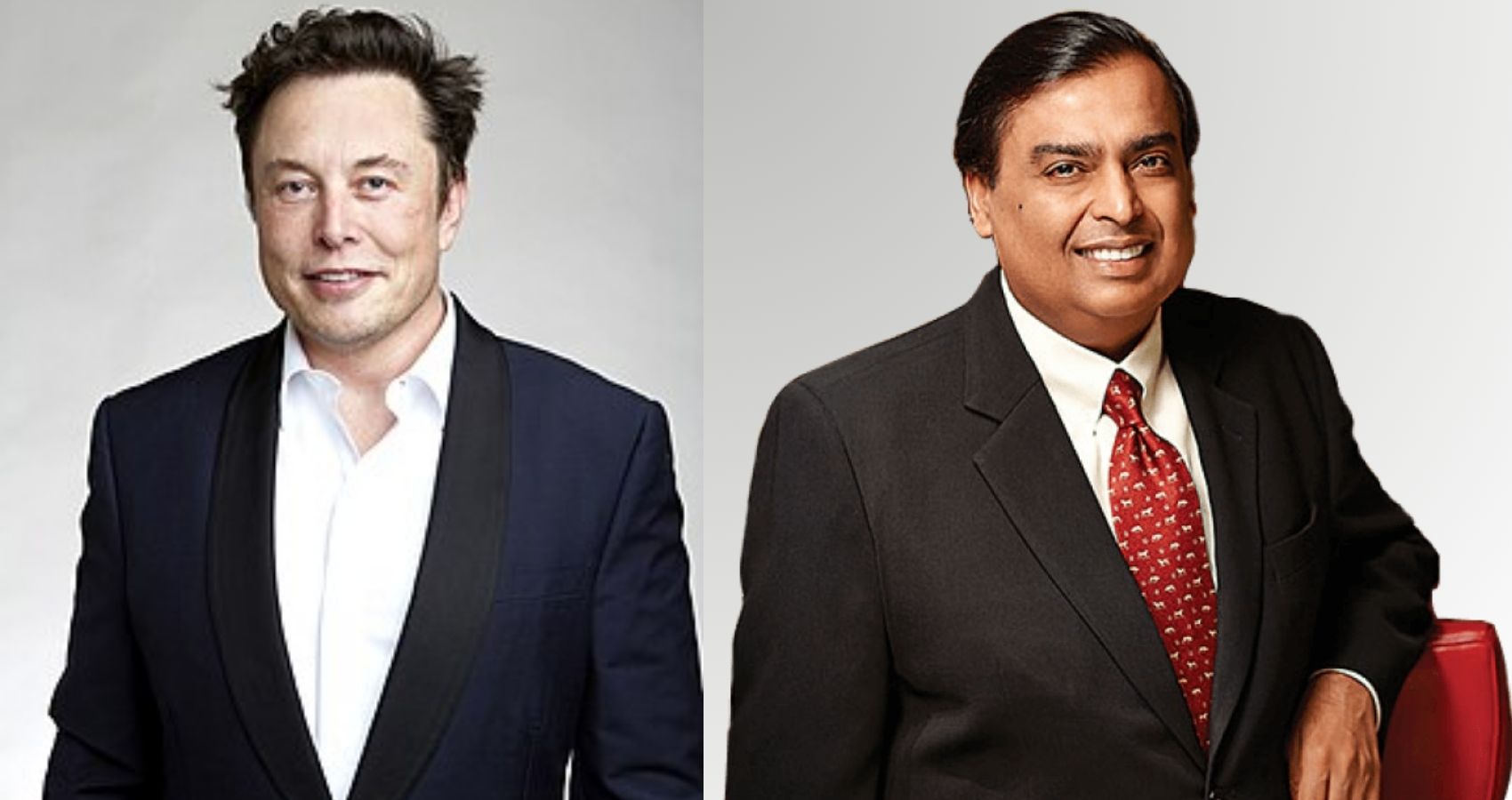
Over the past week, Elon Musk has taken to X with unusually sharp rhetoric aimed at Mukesh Ambani. He has labeled the Reliance Industries chairman the “real boss of India,” sarcastically addressed him as “Prime Minister Ambani,” and accused unnamed oligarchs of maintaining a “monopolistic chokehold” on the Indian people by blocking Starlink. Indian officials have rejected the claims as baseless, noting that Starlink, Bharti-backed Eutelsat OneWeb, and Jio Satellite Communications sit at roughly the same stage of the process: licensed but awaiting security clearances and spectrum allocation before commercial service can begin.
The public spat is real. The deeper contest is larger.
Starlink’s path into India matters because the country is one of the last major markets capable of materially shifting the economics of a global low-Earth-orbit broadband constellation. With a population exceeding 1.4 billion, a rapidly growing digital economy, and persistent last-mile gaps in rural and remote areas, India offers scale that few other open markets can match. Starlink already operates in more than 160 countries and has signed distribution agreements with both Jio and Airtel. Yet commercial launch remains stalled after years of regulatory engagement. For a company whose business model depends on volume to justify continuous satellite manufacturing and launch cadence, delayed access to a market of this size is not a minor setback.
An Indian alternative that reaches commercial viability would change the global calculus. Reliance Jio has outlined plans for an indigenous constellation of roughly 1,600 LEO satellites, with a test flight targeted for 2027, several hundred satellites by 2030, and the full network by 2035. The proposal is framed around “sovereign satellite connectivity,” with ambitions to keep design, integration, launch, and operations substantially within India. If realized at competitive cost and reliability, such a system would give India domestic control over a critical layer of connectivity infrastructure.
That prospect carries geopolitical weight. Many governments are wary of depending on a U.S.-controlled constellation for essential communications. Starlink is a private company, but like any major American technology platform it operates within a framework of U.S. law, export controls, and national-security priorities. Historical precedent in aerospace and telecommunications shows that home-country governments can and do shape where and how advanced systems are sold or restricted. China is the only other country currently deploying large LEO broadband constellations, but trust barriers remain high for most countries outside Beijing’s immediate orbit. An Indian system that is perceived as more commercially oriented, lower-cost, and less likely to be instrumented for great-power leverage would appeal to governments across Asia, the Middle East, Africa, and parts of Latin America seeking alternatives without full alignment with Washington or Beijing.
India’s own incentives align with this opportunity. It is a democracy that must, in principle, allow competition, yet it also has a clear interest in developing indigenous capability rather than remaining a pure customer of foreign systems. Success would reinforce India’s position as a technology hub capable of scaling complex hardware and software systems. The country already possesses a large pool of engineers, including substantial numbers of professionals with experience in U.S. technology firms, alongside lower operating costs relative to Western peers. Building a viable satellite-broadband player would not automatically make India the dominant global tech power, but it would demonstrate the ability to compete in capital-intensive, high-barrier domains rather than primarily in software services and mobile applications.
The recent exchanges between Musk and Ambani therefore sit at the intersection of commercial rivalry and strategic positioning. Musk’s posts emphasize consumer benefits while questioning whether private interests are shaping the pace of approvals. The Indian government maintains that its framework is technology-neutral and non-discriminatory. Jio, for its part, is simultaneously preparing its own constellation and has previously agreed to distribute Starlink services once clearances are obtained. The relationship is competitive, complementary, and entangled.
The stakes could not be higher. If Starlink succeeds in establishing dominance in India, it will lock in the distribution partnerships, ground infrastructure, regulatory familiarity, and customer relationships needed to dominate global satellite broadband for the next decade. Scale in the world’s most populous major market would reinforce SpaceX’s already commanding lead in operational satellites and launch cadence, leaving little room for later challengers. Conversely, if India succeeds in fielding its own competitive system, it will not merely serve its domestic market—it will become a global leader in a critical infrastructure layer, able to buy and integrate technology on its own terms while wielding the leverage that comes with offering a credible, lower-cost, more neutral alternative to much of the developing world. Every major technology company remains ultimately answerable to its home government; an Indian constellation would give New Delhi influence that a pure customer relationship never could. My bet is on India.
Joseph Bamberger is a business leader with extensive relationships with India’s leading businessmen.