
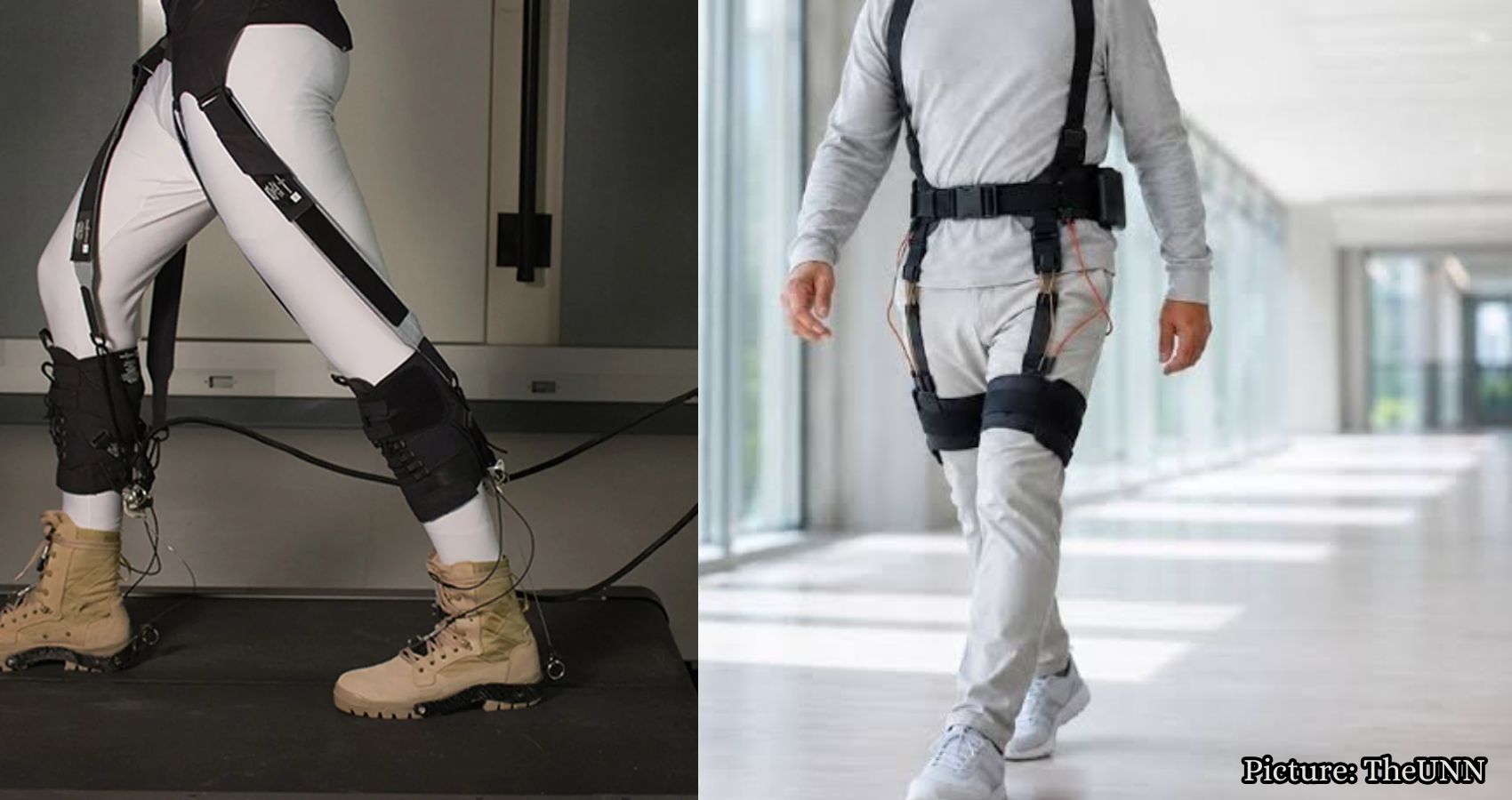
A lightweight soft exosuit utilizing artificial muscles has demonstrated a nearly 14% reduction in energy expenditure during walking, potentially aiding mobility for older adults and those with movement challenges.
Researchers in China have developed a 4.2-pound soft exosuit designed to assist individuals in walking more efficiently, particularly as they age. This innovative device employs artificial muscles instead of traditional motors, offering a promising solution for enhancing mobility.
The soft exosuit, which fits around the waist and thighs like a harness, was tested in a controlled treadmill environment with six healthy adults. The results indicated that participants used an average of 13.9% less energy while walking with the powered assistance activated. Additionally, sensors revealed a decrease in muscle activity, suggesting that the exosuit effectively lightened the load on the wearer’s legs.
Unlike conventional robotic exoskeletons that rely on rigid motors and gearboxes, this new soft exosuit utilizes flexible muscle-like fibers strategically positioned near the hips. As the wearer walks, these fibers engage to assist in leg movement, transferring the pulling force through straps to the hips and thighs. This design allows for a more natural range of motion, as it does not confine the legs within a rigid frame.
The artificial muscles are crafted from a rubber-like material known as dielectric elastomer, which changes shape when exposed to an electric field. While researchers have explored dielectric elastomers for years, earlier iterations lacked the necessary force to aid human movement and were often too bulky for comfortable wear. Wei Yu and his team at Hebei University of Technology have made significant advancements by altering the molecular structure of the material, resulting in thinner, more effective fibers.
To enhance performance, the researchers grouped several fibers into bundles, mimicking the function of human muscle, where multiple smaller fibers work together to generate greater force. They also designed modular connectors, allowing for the addition of more fibers as needed for increased pulling power. Laboratory tests indicated that the actuators completed over 100,000 cycles, although further studies are required to assess the materials’ durability during everyday use.
During the treadmill tests, participants walked under various conditions: without the suit, with the suit but without powered assistance, and with the assistance activated. The metabolic testing system measured oxygen consumption, while sensors monitored muscle activity. The findings showed that when the exosuit was active, participants expended significantly less energy compared to walking without it, indicating a potential for enhanced endurance during longer walks.
This reduction in energy expenditure could be particularly beneficial for older adults or individuals with mobility challenges, making everyday activities like grocery shopping or family outings more manageable. The soft exosuit’s design may also be less intimidating than traditional exoskeletons, resembling clothing rather than a bulky robotic frame. Future iterations could provide valuable support for those recovering from surgery or experiencing decreased leg strength.
However, before the soft exosuit can be widely adopted, further clinical trials are necessary to determine its safety and effectiveness for various populations, particularly older adults and those with existing mobility issues. Balance and stability are also critical factors, as the current study primarily focused on energy expenditure rather than fall prevention.
The prototype’s battery life currently limits the duration of assistance it can provide, and researchers aim to develop versions that can operate for extended periods without significantly increasing weight. Additionally, the control system must be refined to respond automatically to changes in walking speed and terrain, such as navigating grass or inclines. Voltage requirements for the dielectric elastomer actuators present another challenge, as they often necessitate over 1,000 volts, necessitating robust insulation and comprehensive safety testing for consumer use.
Researchers must also evaluate how the fibers react to sweat and varying temperatures, as well as the impact of repeated bending during daily activities on long-term performance. At this stage, no consumer price or release date has been announced for the soft exosuit.
While the current findings are promising, with a nearly 14% reduction in walking energy use, they are based on a limited study involving only six healthy adults in a controlled environment. More extensive research is needed to establish comfort, safety, and real-world applicability.
The next critical phase involves testing the soft exosuit with older adults and individuals facing mobility challenges, which will provide insight into whether these artificial muscles can genuinely enhance independence and activity levels. For those noticing changes in mobility, consulting with a healthcare professional about available support options remains essential.
This innovative research highlights the potential for a lightweight mobility aid that moves in harmony with the body, offering a more natural alternative to current bulky powered exoskeletons. As developments continue, the soft exosuit could represent a significant advancement in mobility assistance technology, paving the way for a future where walking support is both effective and user-friendly.
For further insights on this topic, refer to the research published in the peer-reviewed journal Science Advances.