
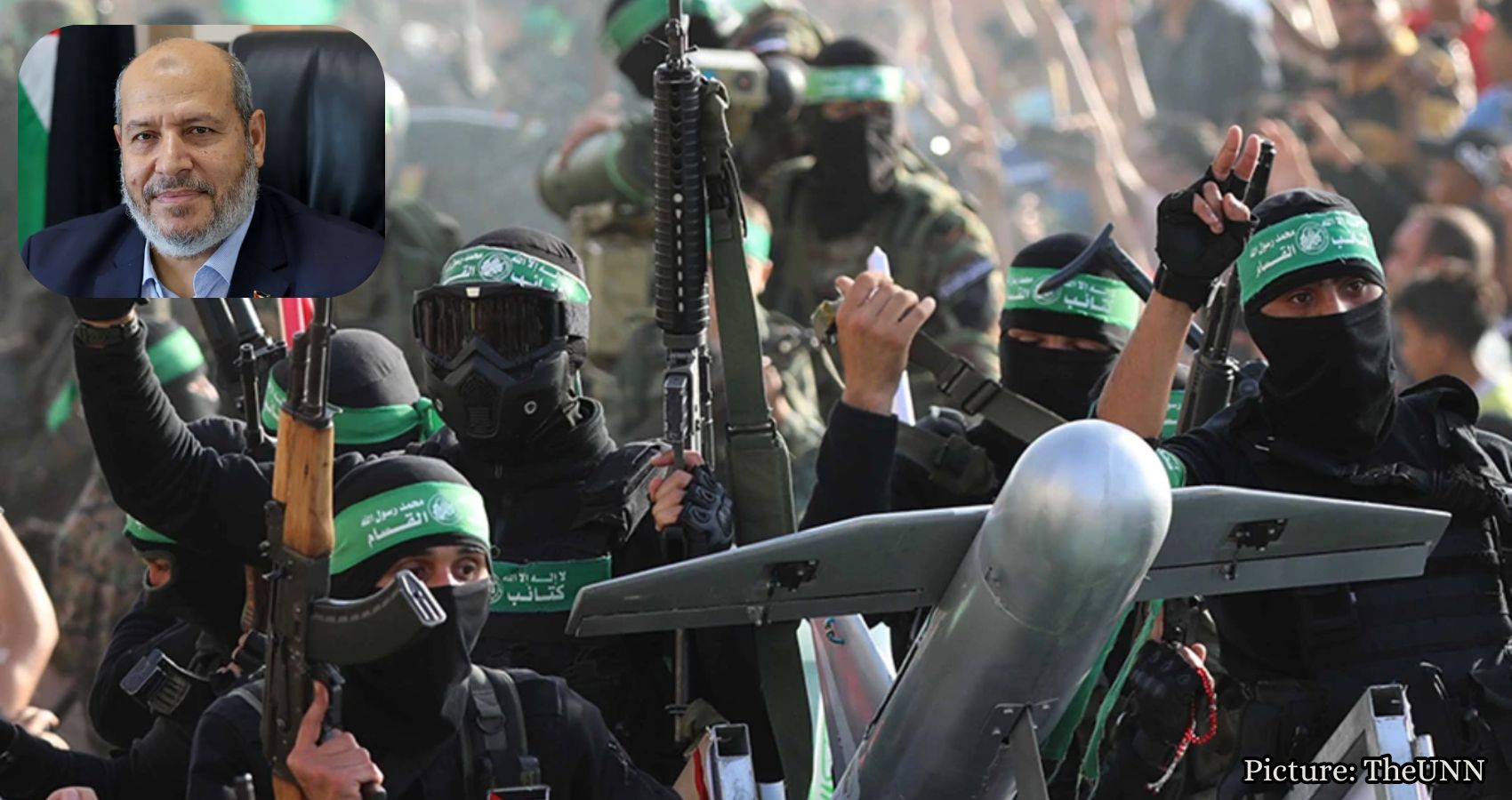
Khalil al-Hayya has been appointed as the new political chief of Hamas, a move that experts interpret as a continuation of the group’s established strategies rather than a shift in direction.
Khalil al-Hayya has been named the new political leader of Hamas following a lengthy and secretive election process. This development, according to experts, signals that the organization is opting for continuity rather than change in its leadership approach.
Al-Hayya, who has served as a key negotiator for Hamas and has survived multiple assassination attempts, will now lead the group’s political bureau. Jaser AbuMousa, a Senior Fellow at the Middle East Institute, emphasized that al-Hayya’s election does not represent a significant shift in Hamas’s strategy. “Expect more of the same, deliberately,” he stated. “Al-Hayya is Hamas’s chief negotiator and its ultimate institutional survivor, so you’ll see continued engagement at the negotiating table, ceasefire talks, and prisoner exchanges, but do not mistake that for moderation.”
AbuMousa described al-Hayya’s election as an act of institutional self-preservation, suggesting that Hamas is reaching for the most familiar leadership in a time of crisis. “He is an experienced operator, and his elevation signals that Hamas, after the destruction of Gaza and the losses since October 7, 2023, has prioritized organizational cohesion, armed continuity, and the preservation of its Iranian relationship over a genuine political reassessment,” he warned.
Reports indicate that several members of al-Hayya’s family, including four of his sons, have been killed in Israeli operations. In September 2025, Israel reportedly attempted to assassinate al-Hayya in Qatar by targeting a building where the Hamas delegation was staying.
AbuMousa pointed out the paradox of Hamas leadership, noting that the top position has become increasingly perilous. “The top job is essentially a death sentence, which is part of why the chair sat empty for nearly two years after Sinwar was killed,” he explained. Al-Hayya himself survived an Israeli strike in Doha last September, a fact that, in the context of Hamas, serves as a credential rather than a disqualification.
AbuMousa anticipates that al-Hayya will lead in a manner similar to his predecessors, operating mostly out of the public eye and moving between Doha and other mediating capitals. “Expect him to communicate through statements and negotiators rather than public appearances, with real command decentralized so that no single strike can decapitate the movement,” he said. “An organization that rewards those who have suffered most, rather than those who have led best, has no real mechanism to correct course after a catastrophe like this one. That’s what should make anyone nervous.”
While al-Hayya’s personal grief over the loss of his sons is profound, AbuMousa noted that within Hamas, such sacrifices can also serve as political capital that elevates a leader above criticism. “His personal grief is genuine, and inside Hamas that sacrifice also functions as political capital that lifts him above criticism,” he remarked.
Al-Hayya’s ascension follows the death of Yahya Sinwar, who was killed by Israeli forces in October 2024. His rise to power came after a secret election that extended over several months. “After the near-total destruction of Gaza and staggering losses since October 7, Hamas had a moment to reassess, and it chose continuity instead,” AbuMousa stated. “It elevated a loyal survivor tied to Iran and the military wing rather than someone offering a different path.”
AbuMousa cautioned against interpreting the leadership vote as a mandate from the people of Gaza. “This was a closed vote by a leadership council, not an election by the roughly 2 million Gazans whose lives Hamas claims to represent and who haven’t voted since 2006. Many of them blame Hamas for exposing them to this catastrophe,” he said.
Looking ahead, AbuMousa suggested that Hamas’s governance model is unlikely to revert to openly running Gaza. Instead, he predicts a Hezbollah-style arrangement where Hamas retains its weapons and security structures while shedding visible responsibility for governance. “Watch the likely governance model: not a return to running Gaza openly, but a Hezbollah-style arrangement where Hamas sheds visible responsibility while keeping its weapons, its security structures, and a veto over any political deal,” he added.
This analysis underscores the complexities of Hamas’s leadership dynamics and the challenges the organization faces in a rapidly changing geopolitical landscape.
According to Fox News Digital.