
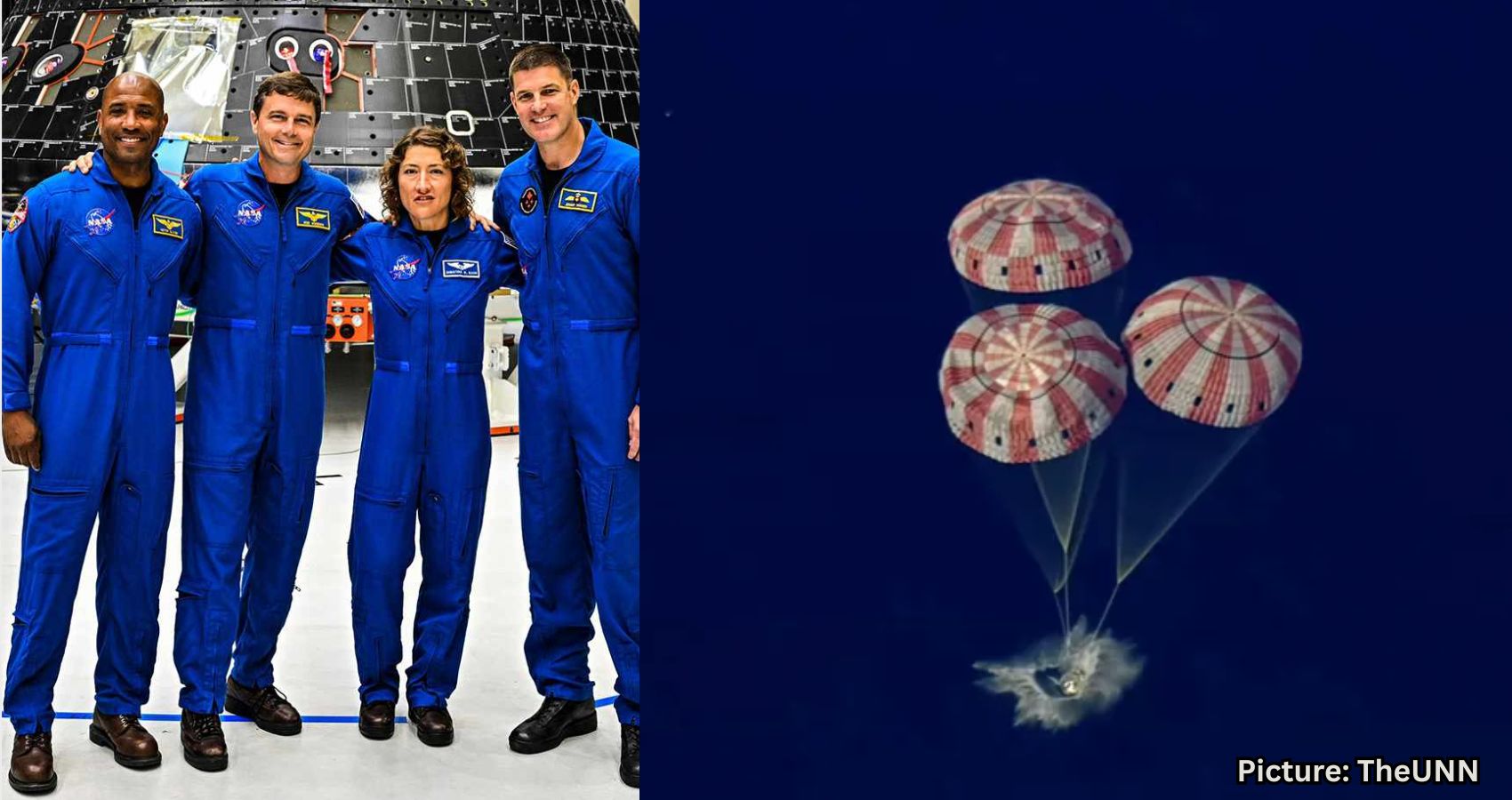
Four astronauts from the Artemis II mission made history with a successful splashdown off San Diego after a 10-day journey around the moon, marking humanity’s return to lunar exploration.
Four astronauts from NASA’s Artemis II mission completed a historic 10-day journey around the moon, splashing down off the coast of San Diego on Friday evening at 5:07 p.m. Pacific Time. This mission represents the first manned lunar expedition in over 50 years.
The crew launched from the Kennedy Space Center on April 1, embarking on a journey that took them approximately 252,000 miles from Earth, farther than any previous crewed mission. NASA Administrator Jared Isaacman, who was on board the USS John P. Murtha for the recovery operation, expressed confidence in the recovery team’s ability to execute their tasks flawlessly.
“I have no doubt that you’re all going to execute this flawlessly as we get these astronauts who will just complete an absolute historic mission, traveling further into space than any humans have gone before,” Isaacman stated.
He emphasized the significance of this mission, saying, “For the first time, we’ve gone into the lunar environment in more than half a century. We are back in the business of sending astronauts to the moon again.” Isaacman also noted that with the planned launch of Artemis III in 2028, which aims to achieve the first moon landing in decades, NASA intends to establish a permanent presence on the lunar surface.
After their splashdown, the astronauts—Commander Reid Wiseman, Pilot Victor Glover, Mission Specialist Christina Koch, and Mission Specialist Jeremy Hansen—were assisted out of the Orion crew module and taken aboard the USS John P. Murtha for medical evaluations.
The Orion spacecraft reentered Earth’s atmosphere at speeds approaching 25,000 mph, utilizing an 11-parachute sequence to slow down to about 20 mph before landing in the ocean approximately 60 miles offshore. During reentry, the exterior of the spacecraft experienced temperatures soaring as high as 5,000 degrees Fahrenheit.
The last crewed mission to the moon occurred in December 1972 with Apollo 17, three years after the historic Apollo 11 mission, which marked humanity’s first landing on the lunar surface in 1969.
This successful mission not only highlights NASA’s renewed commitment to lunar exploration but also sets the stage for future endeavors aimed at establishing a sustainable human presence on the moon.
According to NASA, the Artemis program is a pivotal step in preparing for future missions to Mars and beyond.