
set in Salvador, Bahia, Brazil
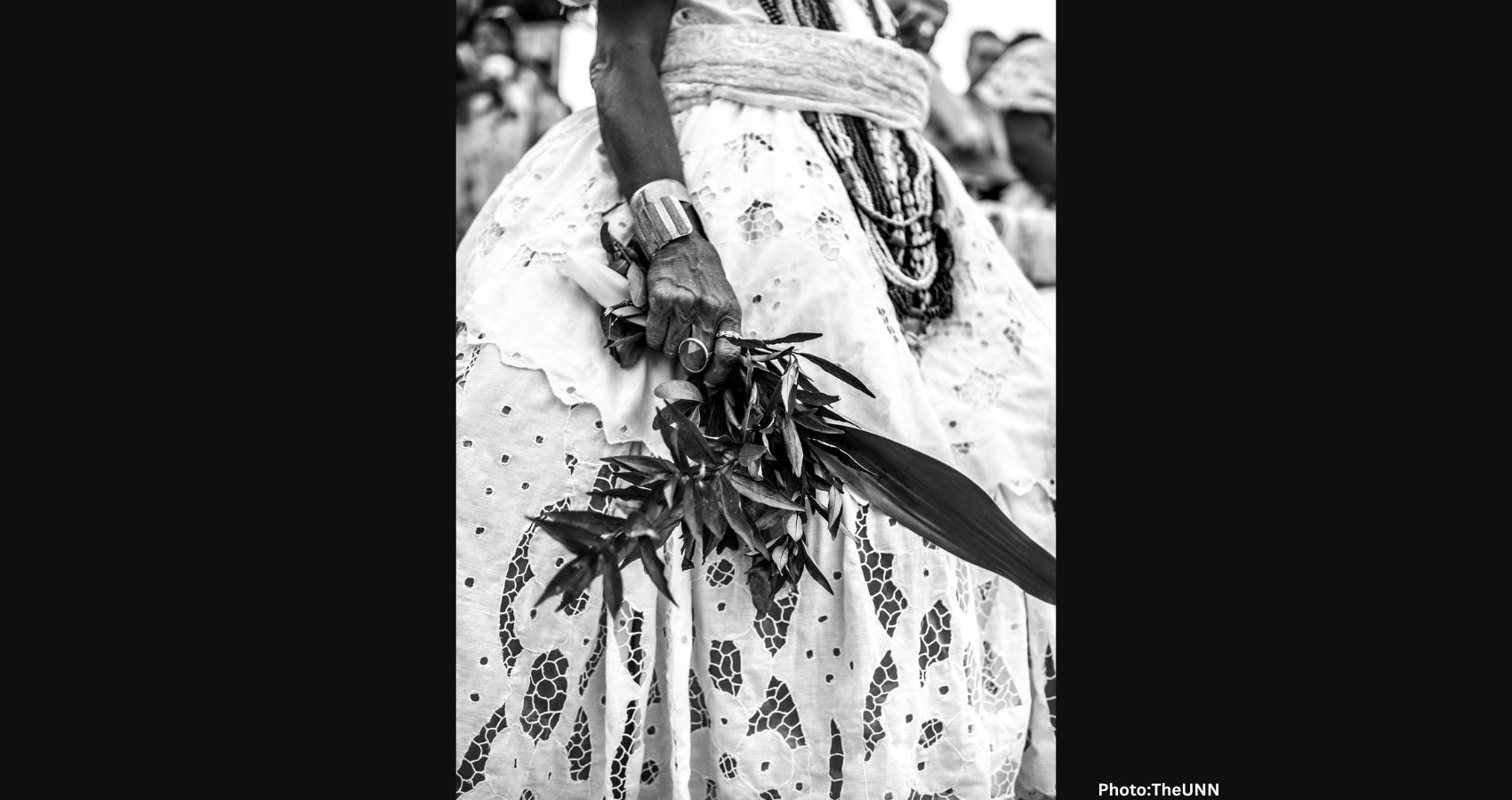
The Saida ceremony takes place in a terreiro of the Ketu nation, located on a rundown street of Salvador, the capital of Bahia. The street is located not in a favela, nor in the centre of the colonial town, but at the end of a downward slope of a hill in between the two sections of the city. It is a poorly maintained area. The cobblestones of the road are chipped, the paint on the blue and pink walls of the buildings is cracked. Only the terreiro has been taken care of by its egbé. It is a wide and rectangular building in the Portuguese style that is identical to other buildings on the road, but it is a freshly painted eggshell white.
The egbé wait inside the terreiro for the new initiates to be brought out and named as part of the nation. It is the middle of the night. Drums bang loudly as songs are sung and chanted in Yoruba. Mother is one of the senior members of the egbé. She sits attentively in a white plastic chair along the wall with the other elders. Meanwhile, the initiates who have been in this nation for less than a year are sitting on the floor, still learning to be one with their orixá.
How nice it is, that the orixá is open to all. You can be black, you can be Korean, you can be Japanese, you can be a woman…you can be anyone. It was different in my case. I was born into this religion because my mother was in this religion, and my father was in this religion, and their mothers and fathers were, too. We were born as descendants of the Yoruba. We have been proud members of the Ketu nation since it was formed. I have had a relationship with the orixá since before my birth. But it does not matter if one is visited by Iemanjá or Nanã, Xangô or Oya. You have to be open to the orixá as much as you would be open to the rain falling on your head or the wind howling in your ear. If you listen to them, if you want to truly learn from them, if you want to seek oneness from them all, they will give you their wisdom, their courage, and their love.
Mother looks down at one of these initiates. He is a German-looking man with all of his hair shaved off. She locks eyes with him. They aren’t really meant to chat with anyone, but Mother cannot help but break into a smile, and he smiles back.
Iemanjá, you are the guardian of the oceans. You keep me open and warm. Thank you for reminding me to take care of my son, no matter what. And thank you for reminding me that though my son may be my biological son, all of this earth’s children, they are my children also, and they deserve attention, dedication, and understanding.
Mother and the initiate keep smiling at each other. It is only when the newest initiate is brought in that they break eye contact. This initiate is a tall and commanding young man. He is an African. The white dots drawn with powder over his black body speckle like starlight. He wears a white gown which doesn’t fit him well, making the pecs of his chest pop out. His neck and arms are adorned with collars made out of shell. He swings his arms outwards and inwards to the beat of the drums.
As he circles the room and follows his pai de Santo, who is chanting and clanging a bell, there are three others behind him. One is chocolate-coloured, the other is olive-skinned, and the third is white, with his flowing curly locks and makeup styled like that of a woman. They gather around, presenting themselves to the pais and mais of Santo, as well as to the seniors who sit on the chairs and the older initiates who are seated on the floor. Mother looks each one of them in the eye.
You have been chosen by the orixá. My orixá also accepts you. You have been welcomed to the Ketu nation. I feel it in my bones, and I accept you as a brother or sister or whatever you want to be called.
After they finish this round of the initiation, they kneel and lay down their bodies to the pais and mais of the terreiro. The pais and mais give them their blessings with their hands. The initiates clap on the floor in the same beat as the drums.
I miss my son. I wish he chose this religion. I wish he chose us also.
But you chose your own beliefs over him.
That’s not how it was, Iemanjá. You don’t understand. I don’t want to get into this. I don’t want to feel guilt over a decision that was made so many years ago.
The point is, he made his choice. You are making your choice. But your choice is making you suffer. Are you sure it was the right one?
The dancing begins. The mais and pais de Santo wobble in circles around the altar. They are joined by initiates and elders. Whoever wants to joins in the chants. The initiates return from their visits to the pains and mais and dance.
This isn’t the time for this chat. You must dance.
Yes, Iemanjá. We are here on a joyous occasion. We must dance.
Mother joins in. She circles the altar, which has in its centre a statue of the Mother Mary in the style of Our Lady of Navigators, who also symbolises the devotion to the goddess of the ocean, Iemanjá.
My holy mother, I am listening to you. I am in communication with you. I am one with you. Let me be your horse. I would love to be your ride.
Mother twists her body leftwards and rightwards. She closes her eyes. The sounds of the drums grow louder. More and more people are joining in. The room becomes crowded, sweaty, full of heat.
Where are you? I am waiting for you. Let me receive you. I am here to be received.
Others join in the singing of the chants. Others speak to themselves, trilling loudly, interrupting their dancing with eclectic hand movements. There is a person who appears to be possessed. A mai de Santo takes him to an anteroom so that he may be properly dressed.
Where are you, Iemanjá?
Mother swerves and rocks her body.
Where are you? Where have you gone?
The others continue dancing. Mother stops and pauses. She focuses on her breath. She is sweating a lot. She takes a handcloth and wipes herself. Then she closes her eyes again. She’s not dancing in the same motions as the rest of the crowd. She stands, bobs her body, her eyes shut.
This nation is my family. This egbé is my home. You do not have to remain with me for me to know this. I know this for myself. I love being a part of this community. I love these people for who they are. They don’t have to love me. They don’t have to know me. I only have to show love. That is enough.
Mother’s eyes open. Mother’s forehead no longer sweats. She dances for the rest of the night, singing along to the Yoruba chants when she can, focusing on keeping her breath in rhythm with her people’s.