
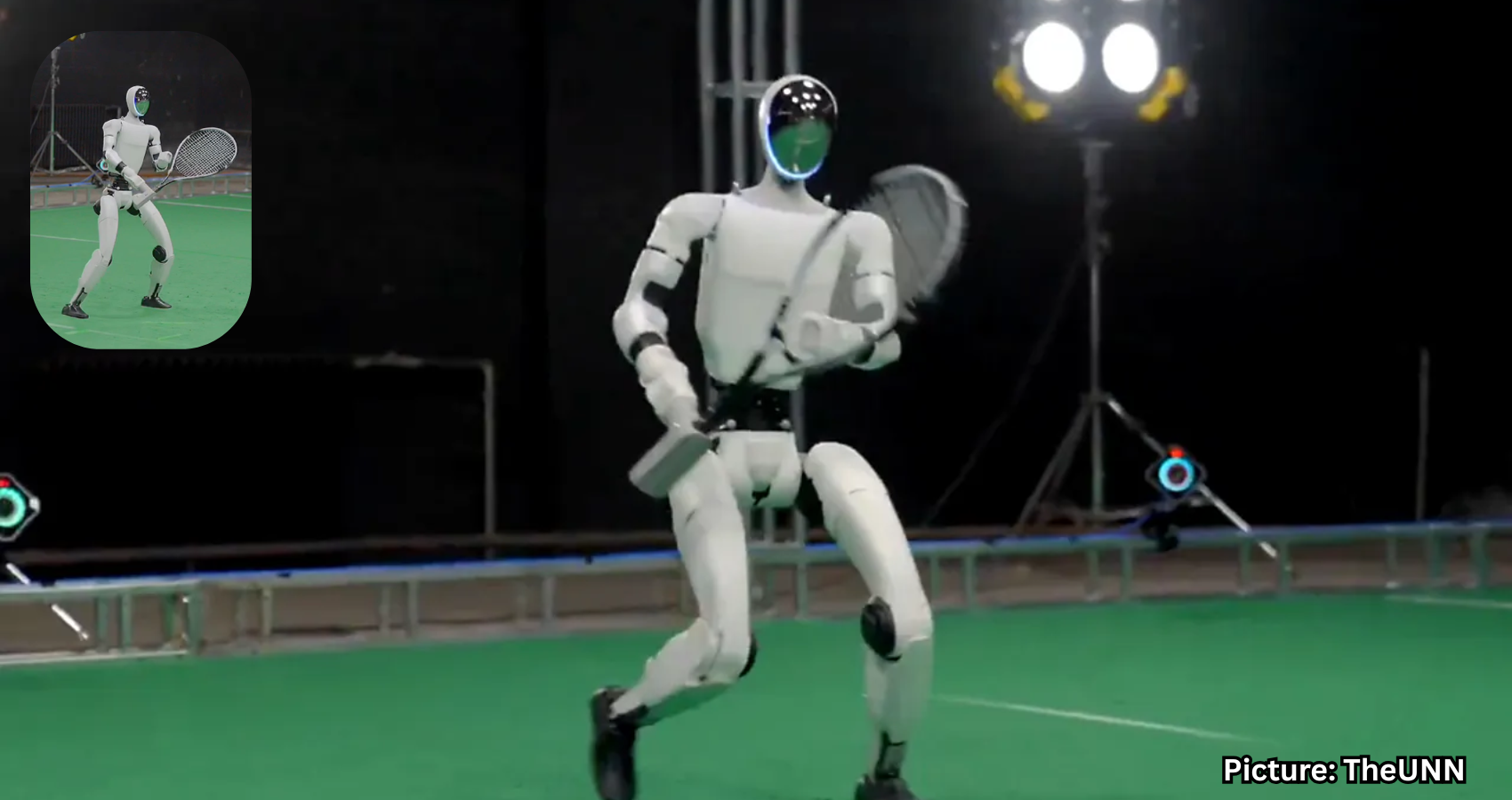
A humanoid robot has demonstrated the ability to play tennis with a human in real time, utilizing AI technology to track and respond to shots without pre-programmed scripts or remote control.
A humanoid robot has made headlines by rallying tennis shots with a human player in real time. This innovative robot operates without a script or remote control, allowing it to react instantly on the tennis court.
Standing at approximately 4 feet tall, the robot features a compact, human-like frame. Developed by Galbot Robotics, a recent video showcased the robot engaging in a series of shots with a human opponent. The underlying technology, known as LATENT, operates on the Unitree G1 platform.
Unlike many athletic robots that follow pre-programmed routines or rely on remote control, this robot reacts dynamically to its human counterpart. It tracks fast-moving tennis balls, adjusts its position on the court, and returns shots with impressive accuracy. The robot is capable of adapting to changing trajectories and unpredictable shots during rallies, demonstrating significant advancements in robotic performance.
Researchers have noted that the robot can sustain long rallies with millisecond-level reaction times and full-body coordination, marking a major leap forward in robotic capabilities.
Training a robot to play tennis presents a complex challenge. Capturing comprehensive data on human gameplay is difficult, prompting researchers to adopt a different approach. Instead of recording entire matches, they concentrated on smaller segments of movement.
Over the course of their research, the team gathered approximately five hours of motion data from five players. These training sessions took place on a compact 10-by-16-foot court, which is more than 17 times smaller than a standard tennis court.
The robot’s ability to play tennis during live rallies is rooted in its learning process. Initially, the system learns individual movements, which are then combined into coordinated sequences. This method allows the robot to improve its performance significantly.
To further enhance its capabilities, the research team trained the model in simulated environments, varying physical conditions such as mass, friction, and aerodynamics. This simulation training enables the robot to adapt to real-world unpredictability, allowing it to respond dynamically rather than adhering to a fixed routine.
In testing, the system achieved an impressive success rate of up to 96% on forehand shots in simulation. In real-world trials, the robot has demonstrated the ability to sustain rallies with a human player and consistently return the ball over the net.
Observing the demonstration, the robot appears competitive, occasionally placing shots strategically away from the human player. This behavior suggests that the robot is capable of more than mere reaction; it indicates early forms of decision-making abilities.
Despite these advancements, there are still limitations. At times, the robot may appear unstable, and its movements are not yet as fluid as those of a trained athlete. Additionally, high or unpredictable shots can still pose challenges. Nevertheless, the progress made thus far is evident.
This breakthrough in robotics extends beyond the realm of tennis. It illustrates how robots can learn complex human skills without the necessity of perfect data. The methodologies employed in this research could potentially be applied to various tasks that lack complete motion data.
The future of robotic capabilities in sports is becoming increasingly clear. Today, the robot is able to rally; tomorrow, it may compete against human players. In the not-so-distant future, robots could train alongside or challenge professional athletes, and exhibition matches between humans and machines may become a regular feature in the sport.
This demonstration highlights the rapid advancements in robotic technology. Robots are no longer limited to following scripts; they can now react, adjust, and compete in real-time scenarios. What once seemed like a distant possibility is now becoming a reality.
The question remains: If a robot could outperform you on the tennis court, would you still be eager to compete, or would you prefer to train alongside it? Share your thoughts with us at Cyberguy.com.
According to CyberGuy, the implications of this technology could reshape not only sports but also various fields that require complex human-like skills.