
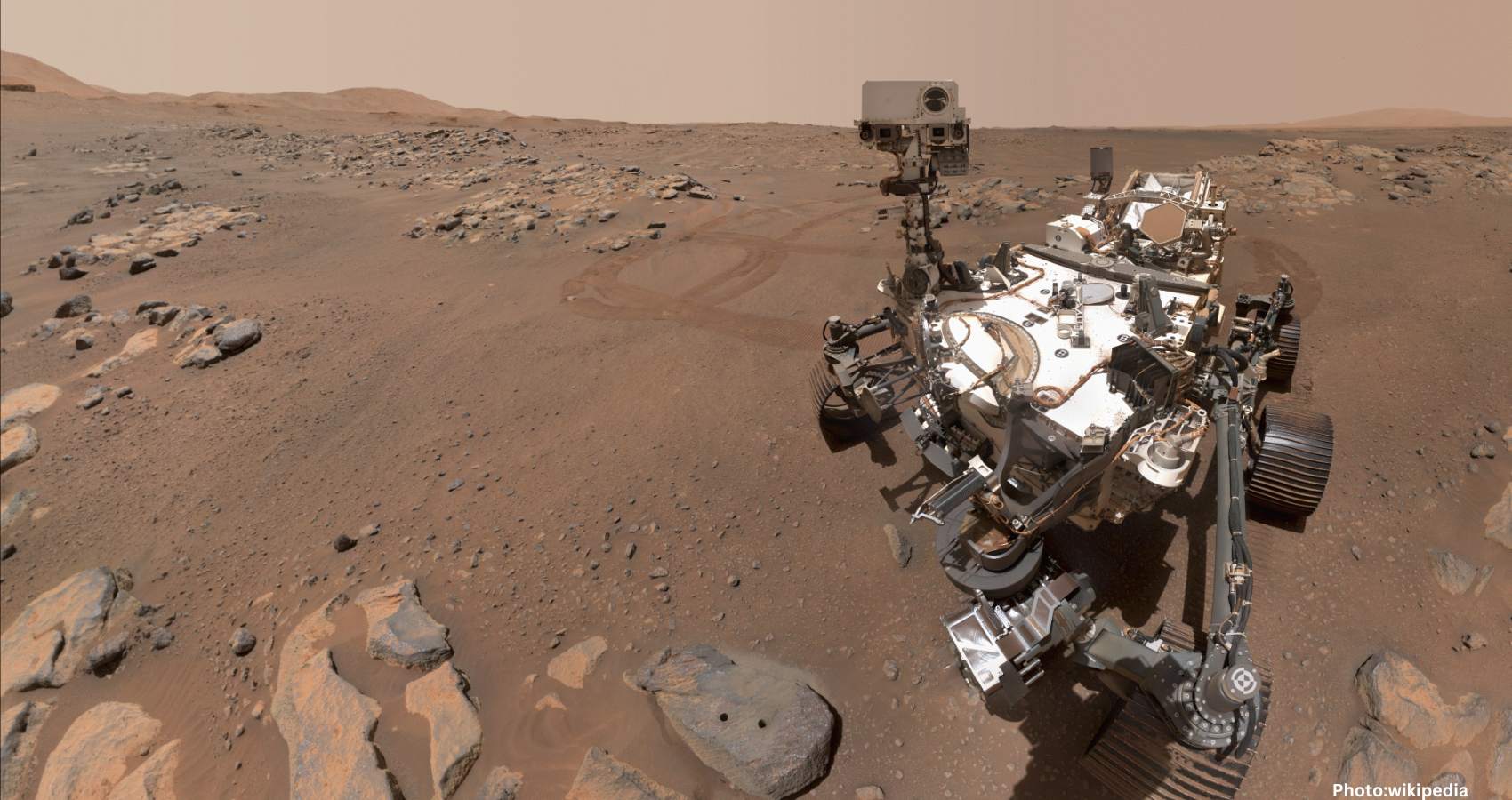
NASA’s Perseverance rover has discovered a shiny metallic rock on Mars, potentially a meteorite from an ancient asteroid, containing high levels of iron and nickel.
NASA’s Perseverance rover has made an intriguing discovery on the Martian surface: a shiny metallic rock that scientists believe could be a meteorite originating from an ancient asteroid. This rock, nicknamed “Phippsaksla,” stands out against the flat, broken terrain surrounding it, prompting further investigation by NASA scientists.
Recent tests conducted on the rock revealed high concentrations of iron and nickel, elements commonly found in meteorites that have impacted both Mars and Earth. While this is not the first instance of a rover identifying a metallic rock on Mars, it could mark Perseverance’s inaugural discovery of such a specimen. Previous missions, including Curiosity, Opportunity, and Spirit, have uncovered iron-nickel meteorites scattered across the Martian landscape, making it noteworthy that Perseverance had not encountered one until now.
Located just beyond the rim of Jezero Crater, Phippsaksla is perched on ancient bedrock formed by past impacts. If confirmed as a meteorite, this finding would align Perseverance with its predecessor rovers that have examined fragments of cosmic visitors to the red planet.
To analyze the rock further, the team directed Perseverance’s SuperCam—a sophisticated instrument that employs a laser to assess a target’s chemical composition—at Phippsaksla. The readings indicated unusually high levels of iron and nickel, a combination that NASA suggests strongly points to a meteorite origin.
SuperCam, mounted on the rover’s mast, vaporizes tiny bits of material with its laser, allowing sensors to detect elemental compositions from several meters away. This capability is crucial for understanding the geological history of Mars and the materials that exist on its surface.
The significance of this discovery lies in the fact that iron and nickel are typically found together only in meteorites formed deep within ancient asteroids, rather than in native Martian rocks. If Phippsaksla is confirmed as a meteorite, it would join a notable list of meteorites identified by earlier missions, including Curiosity’s “Lebanon” and “Cacao,” as well as metallic fragments discovered by Opportunity and Spirit. Each of these discoveries has contributed to scientists’ understanding of how meteorites interact with the Martian surface over time.
Given that Phippsaksla is situated atop impact-formed bedrock outside Jezero Crater, NASA scientists believe its location could provide insights into the rock’s formation and its journey to its current position.
As the agency continues to study Phippsaksla’s unique composition, they aim to confirm whether it indeed originated from beyond Mars. If validated as a meteorite, this find would represent a significant milestone for Perseverance and serve as a reminder that even on a planet 140 million miles away, there are still unexpected discoveries waiting to be uncovered.
Perseverance, NASA’s most advanced robotic explorer to date, traveled 293 million miles to reach Mars after launching aboard a United Launch Alliance Atlas V rocket from Cape Canaveral Space Station in Florida on July 30, 2020. It successfully landed in Jezero Crater on February 18, 2021, where it has spent nearly four years searching for signs of ancient microbial life and exploring the Martian surface.
Constructed at NASA’s Jet Propulsion Laboratory in Pasadena, California, Perseverance is a $2.7 billion rover measuring approximately 10 feet long, 9 feet wide, and 7 feet tall—making it about 278 pounds heavier than its predecessor, Curiosity. Powered by a plutonium generator, Perseverance is equipped with seven scientific instruments, a seven-foot robotic arm, and a rock drill that enables it to collect samples that could eventually be returned to Earth. This mission also plays a crucial role in NASA’s preparations for future human exploration of Mars, anticipated in the 2030s.
Source: Original article