
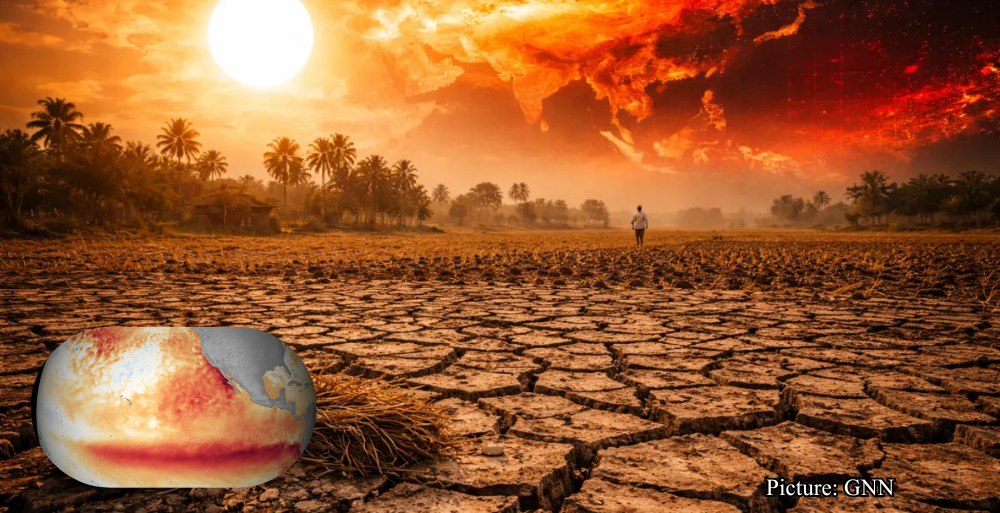
The National Oceanic and Atmospheric Administration forecasts a significant shift to El Niño conditions by summer 2026, raising concerns about the potential for a powerful “Godzilla” event.
The National Oceanic and Atmospheric Administration (NOAA) has issued an El Niño Watch, predicting a 62% chance that this climate pattern will emerge between June and August 2026. This forecast follows a weakening La Niña phase and a brief period of ENSO-neutral conditions expected through the spring. While federal forecasts remain cautious about the event’s ultimate intensity, independent meteorologists and historical data models indicate the possibility of a “very strong” or “Godzilla” El Niño, reminiscent of the record-breaking events of 1997-1998 and 2015-2016. Such a development could significantly alter global weather patterns, potentially suppressing Atlantic hurricanes while intensifying Pacific swells and extreme precipitation across the Southern United States.
In a recent briefing, federal climate scientists confirmed that the global weather system is shifting back toward a warming phase, marking the end of the recent La Niña cycle. The Climate Prediction Center (CPC) at NOAA now estimates a 62% likelihood of El Niño conditions forming by summer 2026, a transition that could have far-reaching implications for global agriculture, disaster preparedness, and coastal communities.
This transition is expected to be preceded by a short period of ENSO-neutral conditions, with a 55% probability of such conditions prevailing through May and July. However, experts have raised alarms about the rapid accumulation of subsurface heat in the equatorial Pacific, suggesting that the upcoming cycle may not be a typical warming event but could evolve into a “Super El Niño.”
An El Niño occurs when the trade winds that typically blow from east to west along the equator weaken or reverse. This change allows a massive “warm pool” of water to migrate from the western Pacific toward the Americas. When this warming is extreme—typically defined by sea surface temperature (SST) anomalies exceeding +2.0°C in the Niño-3.4 region—it is often referred to as a “Godzilla” or “Super” El Niño.
One NOAA scientist described the current atmospheric conditions as “primed” for a significant shift, noting that a considerable amount of heat stored in the deeper ocean is being “unearthed” and moving toward the surface.
Historically, these powerful El Niño events have dramatically reshaped the planet’s thermal profile. The 1997-1998 El Niño, for example, was linked to an estimated $5.7 trillion in global income losses and thousands of deaths due to extreme weather. More recently, the 2015-2016 event saw SST anomalies reach an astonishing +3.5°C, resulting in the most energetic wave season ever recorded on the U.S. West Coast, with beach erosion levels hitting up to 10 feet in some areas of California.
The implications of a “Godzilla” El Niño are complex, particularly for the surfing community and coastal industries. While it promises historically large swells for the Pacific, it also poses risks of infrastructure damage and coastal flooding.
On the West Coast, experts anticipate more frequent hurricane-driven swells during the summer, followed by a winter characterized by powerful North Pacific swells. However, these conditions are often accompanied by “south-wind” storms that can disrupt local surf conditions and lead to severe flash flooding.
On the East Coast, El Niño typically increases vertical wind shear over the Atlantic, which can “tear apart” developing tropical storms. This generally results in a quieter-than-average hurricane season, although warmer-than-normal Atlantic temperatures, exacerbated by climate change, may mitigate this protective effect.
In Hawaii, the islands often experience a “washout” winter during strong El Niño years, marked by massive, unruly swells and persistent rainfall.
Politically and economically, the stakes are equally high. Andrew Kruczkiewicz, a senior researcher at the Columbia Climate School, emphasized that while the impacts of ENSO on weather patterns are nuanced and vary by season, they are never neutral for the economy. He noted that El Niño can serve as a “drought buster” for the parched Southern Plains, which have faced a six-year water deficit, but the resulting heavy rains can overwhelm aging infrastructure.
The 2026 forecast comes at a time when the planet’s baseline temperature has already been elevated due to human-induced climate change. The year 2024 currently holds the record for the hottest year in history, achieved through a combination of a strong El Niño and greenhouse gas emissions.
Scientific consensus suggests that while El Niño is a natural cycle, a warming planet makes its effects more volatile. Data from the North American Multi-Model Ensemble (NMME) indicates a 1-in-3 chance that the 2026 event will reach “strong” status by the October–December quarter. If these projections hold, 2027 is statistically likely to surpass 2024 as the warmest year on record.
In California, the memory of the 2015-2016 “Monster” El Niño remains fresh. During that cycle, despite significant oceanic warming, Southern California experienced slightly below-average rainfall, while Northern California faced heavy inundation. This “predictability barrier” continues to challenge forecasters and emergency managers alike.
As the Pacific trade winds begin to weaken, governments are already shifting their focus toward mitigation strategies. In South America, countries such as Peru and Ecuador are reinforcing riverbanks and clearing drainage systems in anticipation of the torrential rains that typically accompany such a significant shift.
In the United States, the emphasis is on the “Relative Oceanic Niño Index” (RONI). Unlike older metrics, RONI measures equatorial warming relative to the rest of the world’s oceans, providing a more accurate picture of how these shifts will influence global storm tracks.
“The whispers of El Niño are becoming a roar,” said Dashel Pierson, an editor specializing in maritime conditions. “Whether it turns into the ‘Godzilla’ some fear or remains a more manageable ‘monster’ depends on how the ocean-atmosphere coupling develops over the next 90 days.”
As of mid-March 2026, the global community remains on “El Niño Watch.” The next comprehensive update from the Climate Prediction Center is scheduled for April 9, 2026, at which point the “spring predictability barrier” will begin to lift, offering a clearer view of the impending storm.
According to GlobalNetNews, the potential impacts of this forecast are significant and warrant close monitoring as the situation develops.