
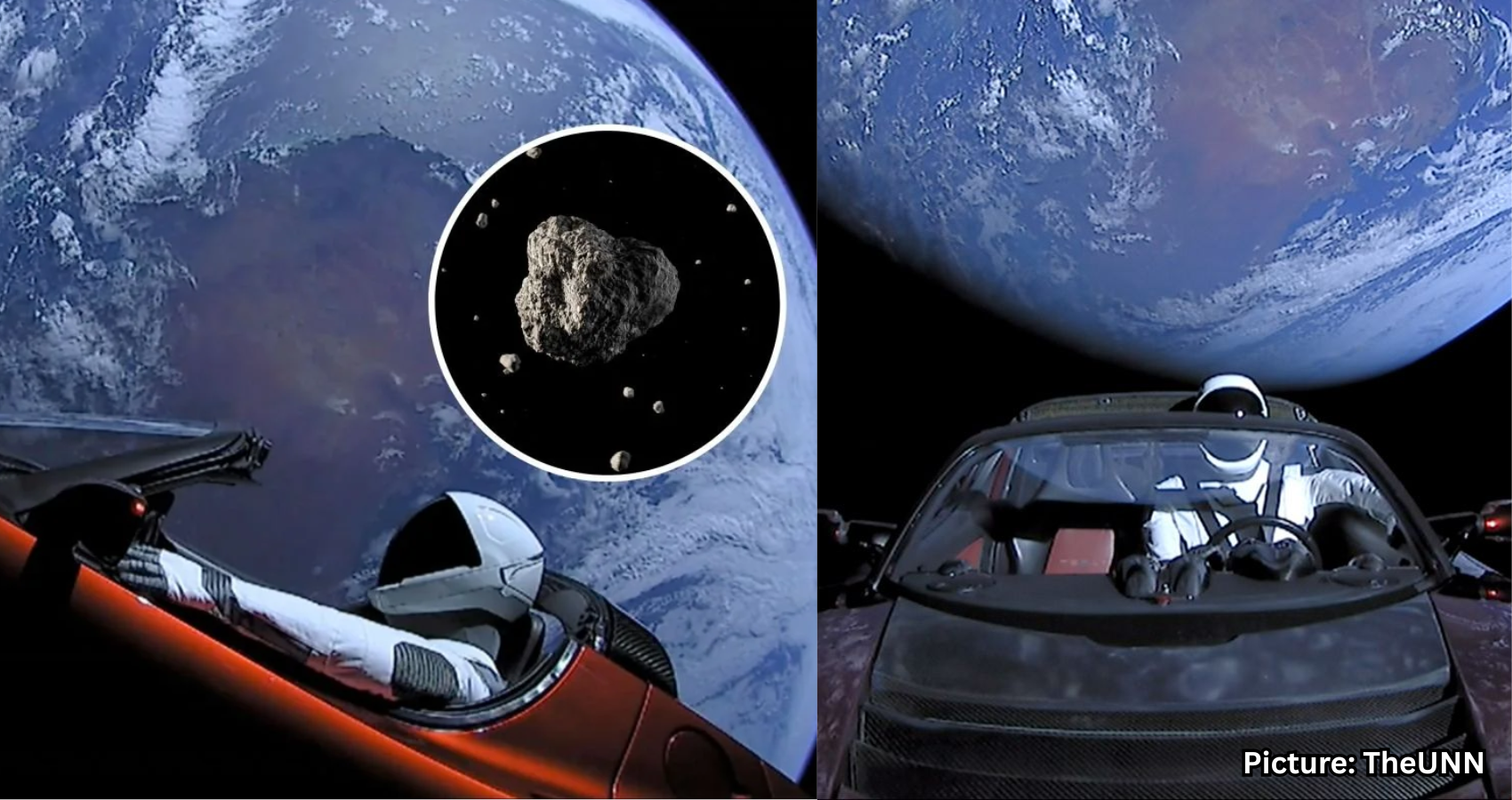
Astronomers recently misidentified a Tesla Roadster launched into space by SpaceX in 2018 as an asteroid, prompting a swift correction from the Minor Planet Center.
Astronomers from the Minor Planet Center at the Harvard-Smithsonian Center for Astrophysics in Massachusetts recently made an amusing error when they mistook a Tesla Roadster for an asteroid. This incident occurred earlier this month, nearly seven years after the car was launched into orbit by SpaceX CEO Elon Musk.
The object, initially designated as 2018 CN41, was registered by the Minor Planet Center but was deleted from the registry just one day later on January 3. The center clarified that the object’s orbit matched that of an artificial object, specifically the Falcon Heavy upper stage with the Tesla Roadster attached. In a statement on their website, they noted, “The designation 2018 CN41 is being deleted and will be listed as omitted.”
The Tesla Roadster was launched during the maiden flight of SpaceX’s Falcon Heavy rocket in February 2018. At the time, it was expected to enter an elliptical orbit around the sun, extending just beyond Mars before looping back toward Earth. However, Musk later indicated that the vehicle exceeded Mars’ orbit and continued on toward the asteroid belt.
When the Roadster was misidentified as an asteroid earlier this month, it was located less than 150,000 miles from Earth—closer than the moon’s orbit. This proximity raised concerns among astronomers, who felt it necessary to monitor the object closely.
Jonathan McDowell, an astrophysicist at the Center for Astrophysics, commented on the implications of this mix-up. He pointed out the challenges associated with untracked objects in space, stating, “Worst case, you spend a billion launching a space probe to study an asteroid and only realize it’s not an asteroid when you get there,” highlighting the potential risks of misidentification.
The incident serves as a reminder of the complexities involved in tracking artificial objects in space, especially as more private companies like SpaceX continue to launch vehicles into orbit.
Fox News Digital has reached out to SpaceX for further comment regarding the incident.
According to Astronomy Magazine, the mix-up illustrates the ongoing challenges in space observation and the importance of accurate tracking systems as the number of objects in orbit continues to grow.