
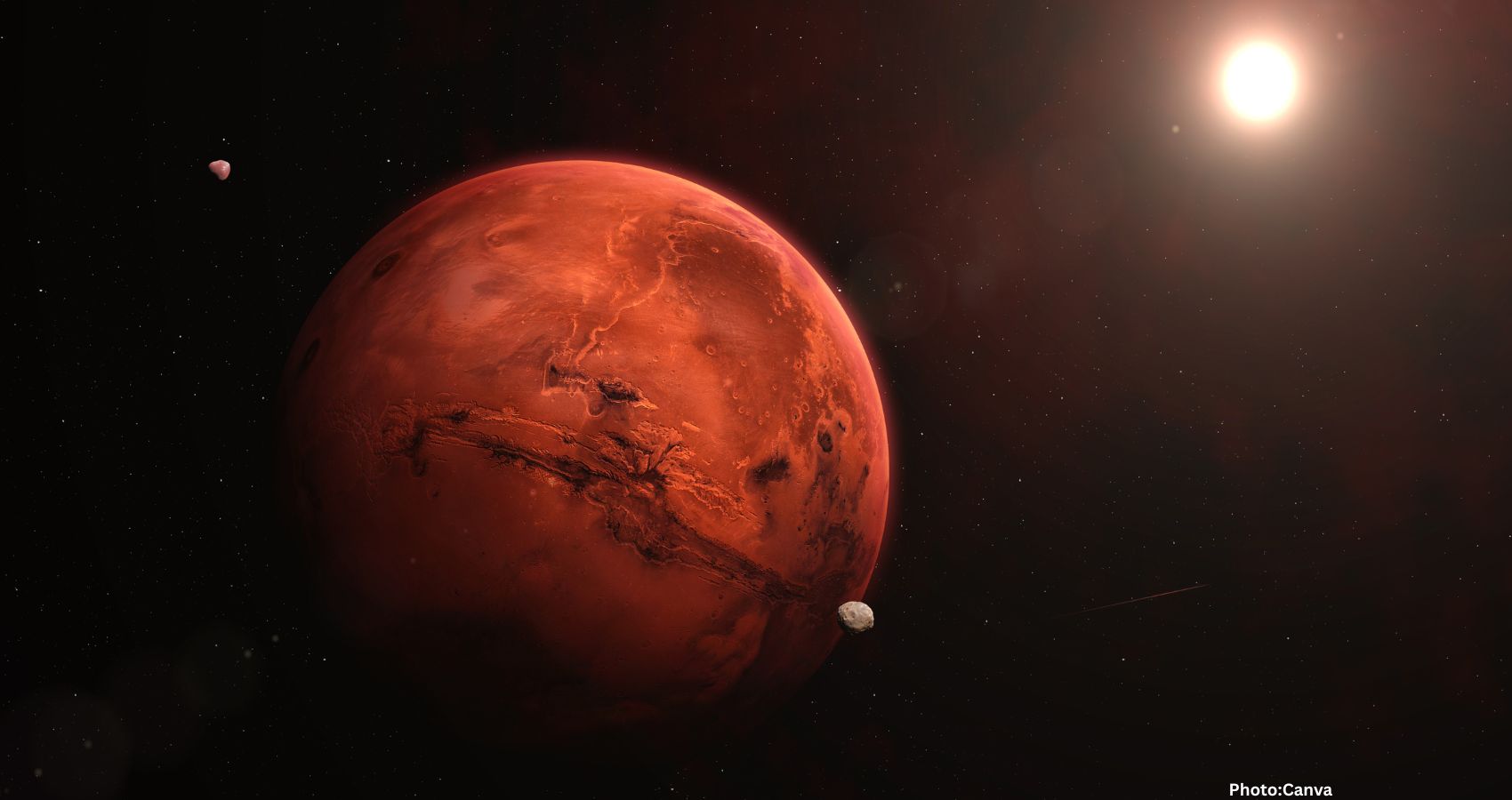
The reddish hue of Mars may be linked to a mineral called ferrihydrite, suggesting the planet once had conditions suitable for liquid water, according to a recent study.
A new study reveals that the mineral ferrihydrite, found in Mars’ dust, is likely responsible for the planet’s distinctive red color. This mineral forms in the presence of cool water, indicating that Mars may have once had an environment capable of sustaining liquid water before transitioning to its current dry state billions of years ago.
The research, published in *Nature Communications*, analyzed data from various Mars missions, including several rovers. The findings were compared to laboratory experiments where researchers tested how light interacts with ferrihydrite particles and other minerals under simulated Martian conditions.
“The fundamental question of why Mars is red has been considered for hundreds, if not thousands, of years,” said Adam Valantinas, the study’s lead author and a postdoctoral fellow at Brown University. Valantinas began this research as a Ph.D. student at the University of Bern in Switzerland. He noted, “From our analysis, we believe ferrihydrite is everywhere in the dust and probably in the rock formations as well.” While previous studies have suggested ferrihydrite as a reason for Mars’ red color, this research provides new observational data and innovative laboratory methods to simulate Martian dust.
Jack Mustard, the study’s senior author and a professor at Brown University, described the research as a “door-opening opportunity.” He emphasized the importance of returning samples from Mars, which are currently being collected by the Perseverance rover. “When we get those back, we can actually check and see if this is right,” Mustard said.
The study suggests that Mars likely had a cool, wet, and potentially habitable climate in its ancient past. Currently, the planet’s atmosphere is too cold to support life, but billions of years ago, it had an abundance of water, as evidenced by the presence of ferrihydrite in its dust.
Geronimo Villanueva, Associate Director for Strategic Science of the Solar System Exploration Division at NASA’s Goddard Space Flight Center and a co-author of the study, remarked, “These new findings point to a potentially habitable past for Mars and highlight the value of coordinated research between NASA and its international partners when exploring fundamental questions about our solar system and the future of space exploration.”
Valantinas expressed the researchers’ desire to understand not only the ancient Martian climate but also the chemical processes occurring on Mars today. He stated, “Then there’s the habitability question: Was there ever life? To understand that, you need to understand the conditions that were present during the time of this mineral’s formation.” The study indicates that for ferrihydrite to form, specific conditions must have existed where oxygen from the atmosphere or other sources reacted with iron in the presence of water. These conditions were markedly different from the current dry and cold environment of Mars.
As Martian winds spread this dust across the planet, they contributed to the iconic red appearance that Mars is known for today.
According to NASA, this research underscores the importance of understanding Mars’ geological history and its potential for past habitability.
For further details, refer to the study published in *Nature Communications*.