
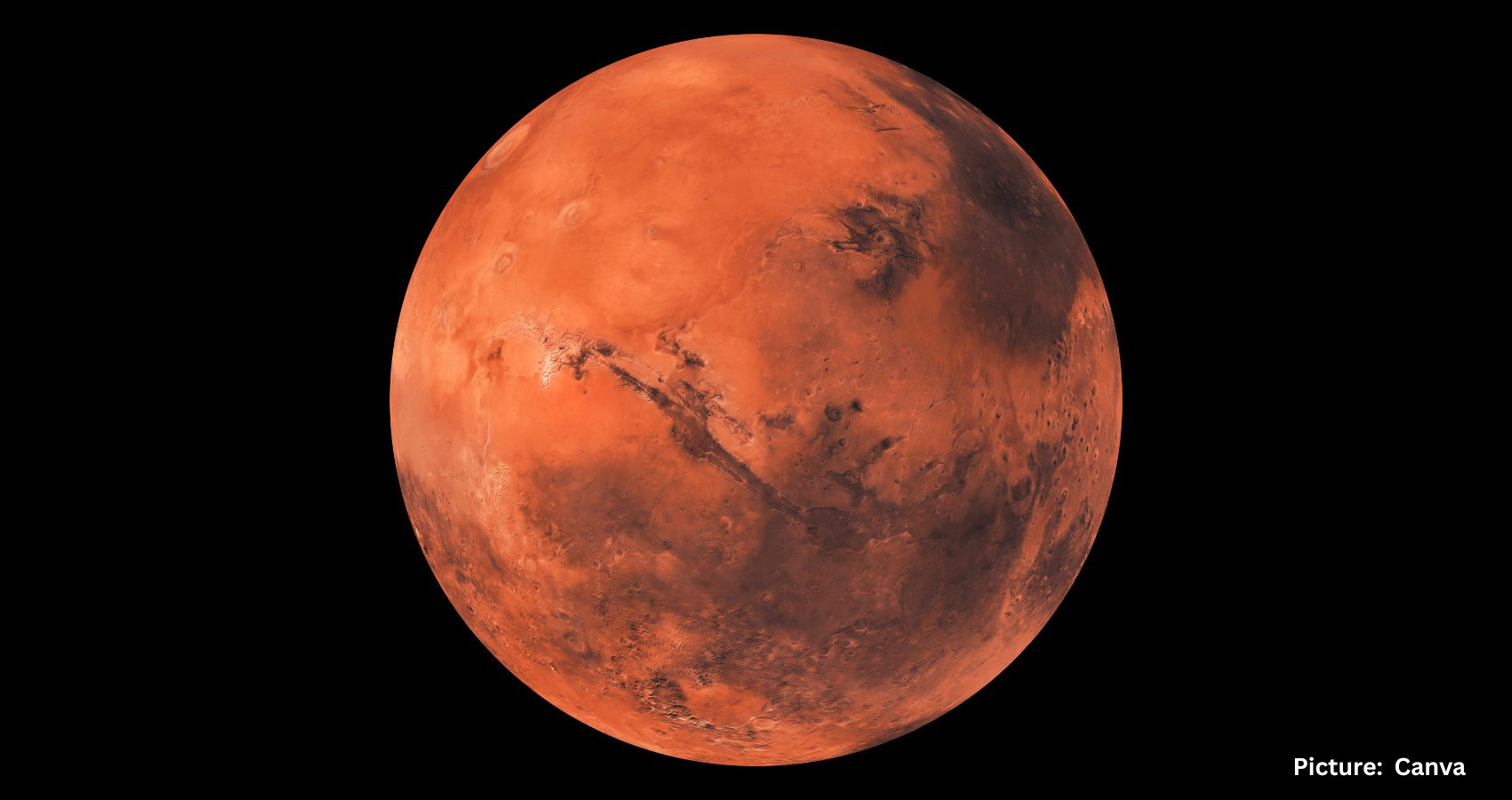
Mars’ distinctive red hue may be linked to a habitable past, according to a new study that highlights the role of the mineral ferrihydrite found in the planet’s dust.
A recent study suggests that the mineral ferrihydrite, which forms in the presence of cool water, is responsible for Mars’ characteristic red color. This finding indicates that Mars may have once had an environment capable of sustaining liquid water before transitioning to its current dry state billions of years ago.
The study, published in Nature Communications, reveals that ferrihydrite forms at lower temperatures than other minerals previously thought to contribute to the planet’s reddish hue, such as hematite. NASA, which partially funded the research, stated that this discovery could reshape our understanding of Mars’ climatic history.
Researchers analyzed data from various Mars missions, including several rovers, and compared their findings to laboratory experiments. These experiments involved testing how light interacts with ferrihydrite particles and other minerals under simulated Martian conditions.
Adam Valantinas, the study’s lead author and a postdoctoral fellow at Brown University, emphasized the significance of the research. “The fundamental question of why Mars is red has been considered for hundreds if not thousands of years,” he said in a statement. Valantinas, who initiated the study as a Ph.D. student at the University of Bern in Switzerland, added, “From our analysis, we believe ferrihydrite is everywhere in the dust and probably in the rock formations as well.” He noted that while previous studies had proposed ferrihydrite as a reason for Mars’ color, their research provides a more robust framework for testing this hypothesis using observational data and innovative laboratory methods.
Jack Mustard, the senior author of the study and a professor at Brown University, described the research as a “door-opening opportunity.” He stated, “It gives us a better chance to apply principles of mineral formation and conditions to tap back in time.” Mustard also highlighted the importance of the samples being collected by the Perseverance rover, which will allow researchers to verify their findings once returned to Earth.
The research indicates that Mars likely had a cool, wet, and potentially habitable climate in its ancient past. Although the planet’s current atmosphere is too cold to support life, evidence suggests that it once had abundant water, as indicated by the presence of ferrihydrite in its dust.
Geronimo Villanueva, Associate Director for Strategic Science of the Solar System Exploration Division at NASA’s Goddard Space Flight Center and a co-author of the study, remarked, “These new findings point to a potentially habitable past for Mars and highlight the value of coordinated research between NASA and its international partners when exploring fundamental questions about our solar system and the future of space exploration.”
Valantinas further elaborated on the goals of the research team, stating, “What we want to understand is the ancient Martian climate, the chemical processes on Mars—not only ancient but also present.” He raised the critical question of habitability, asking, “Was there ever life? To understand that, you need to understand the conditions that were present during the time of this mineral’s formation.” He explained that for ferrihydrite to form, conditions must have existed where oxygen from the atmosphere or other sources could react with iron in the presence of water, contrasting sharply with today’s dry and cold Martian environment.
As Martian winds spread this dust across the planet, they contributed to the iconic red appearance that Mars is known for today.
These findings underscore the importance of continued exploration and research into Mars’ past, as scientists strive to uncover the mysteries of the planet’s history and its potential for supporting life.
According to NASA, the implications of this study could significantly enhance our understanding of Mars and its geological and climatic evolution.