
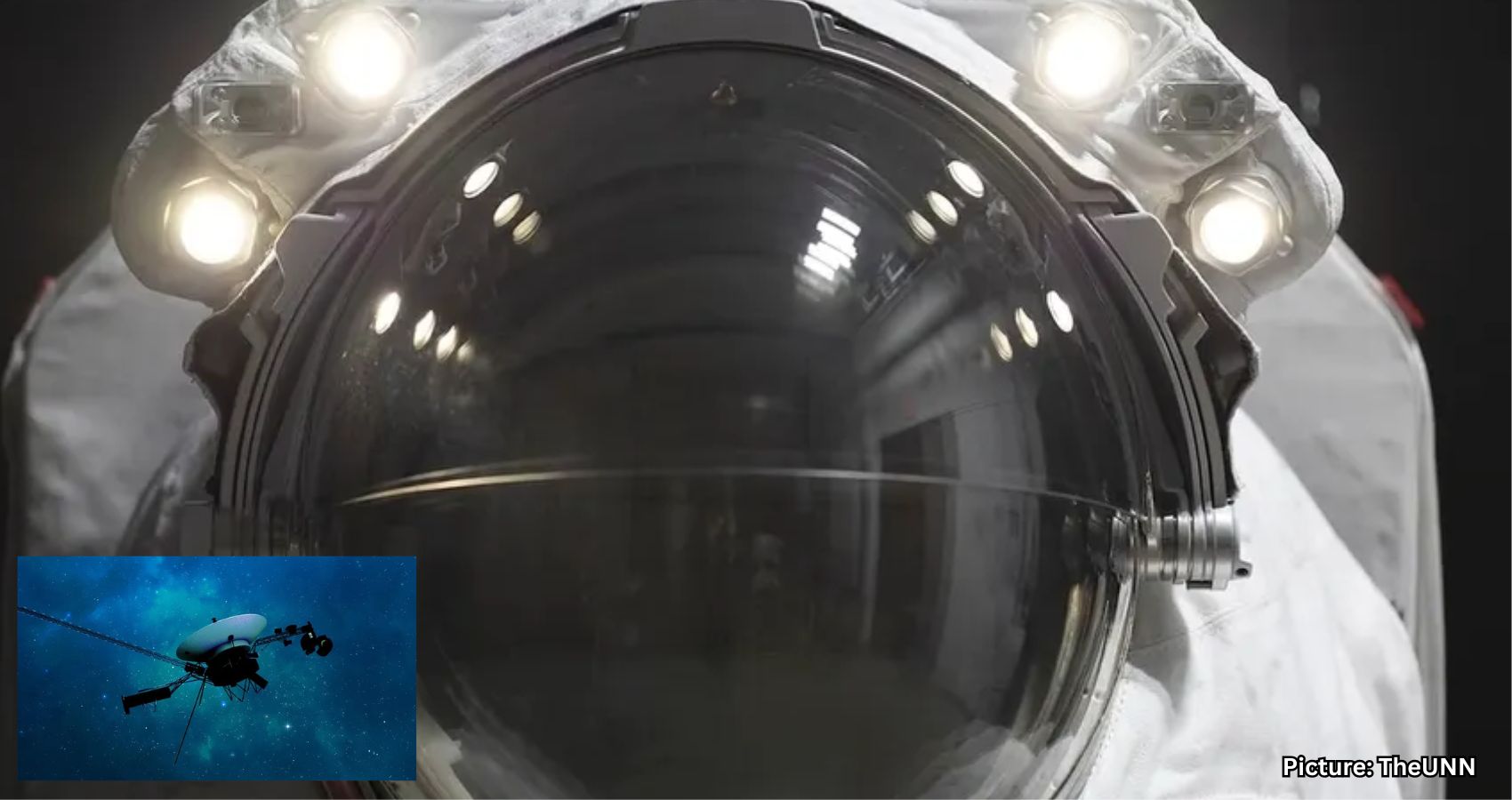
NASA has successfully reestablished communication with Voyager 1 after a temporary pause, allowing the interstellar spacecraft to resume its scientific operations from over 15 billion miles away.
NASA has confirmed that communications with Voyager 1 have resumed following a brief interruption in late October. The spacecraft, which is currently located approximately 15.4 billion miles from Earth, switched to a lower-power communication mode due to a fault protection system activation.
During the communication pause, Voyager 1 unexpectedly turned off its primary radio transmitter, known as the X-band, and activated its much weaker S-band transmitter. This switch to the S-band, which had not been utilized in over 40 years, limited the mission team’s ability to download scientific data and assess the spacecraft’s status.
Earlier this month, NASA engineers successfully reactivated the X-band transmitter, allowing for the collection of data from the four operational science instruments aboard Voyager 1. With communications restored, the team is now focused on completing several remaining tasks to return the spacecraft to its previous operational state.
One of the critical tasks involves resetting the system that synchronizes Voyager 1’s three onboard computers. The S-band was activated by the spacecraft’s fault protection system when engineers turned on a heater on Voyager 1. The system determined that the probe lacked sufficient power and automatically disabled nonessential systems to conserve energy for critical operations.
As a result, all nonessential systems were turned off, including the X-band transmitter, while the S-band was activated to maintain communication with Earth. Notably, Voyager 1 had not used the S-band for communication since 1981.
Voyager 1’s mission began in 1977 when it was launched alongside its twin, Voyager 2, to explore the gas giant planets of the solar system. The spacecraft has since transmitted stunning images of Jupiter’s Great Red Spot and Saturn’s iconic rings. Voyager 2 continued its journey to Uranus and Neptune, while Voyager 1 utilized a gravitational slingshot around Saturn to propel itself toward Pluto.
Each Voyager spacecraft is equipped with ten science instruments, four of which are currently operational on Voyager 1. These instruments are being used to study the particles, plasma, and magnetic fields present in interstellar space.
As the Voyager mission continues, NASA remains committed to monitoring the spacecraft and ensuring its continued success in exploring the far reaches of our solar system and beyond, according to NASA.
Source: Original article