
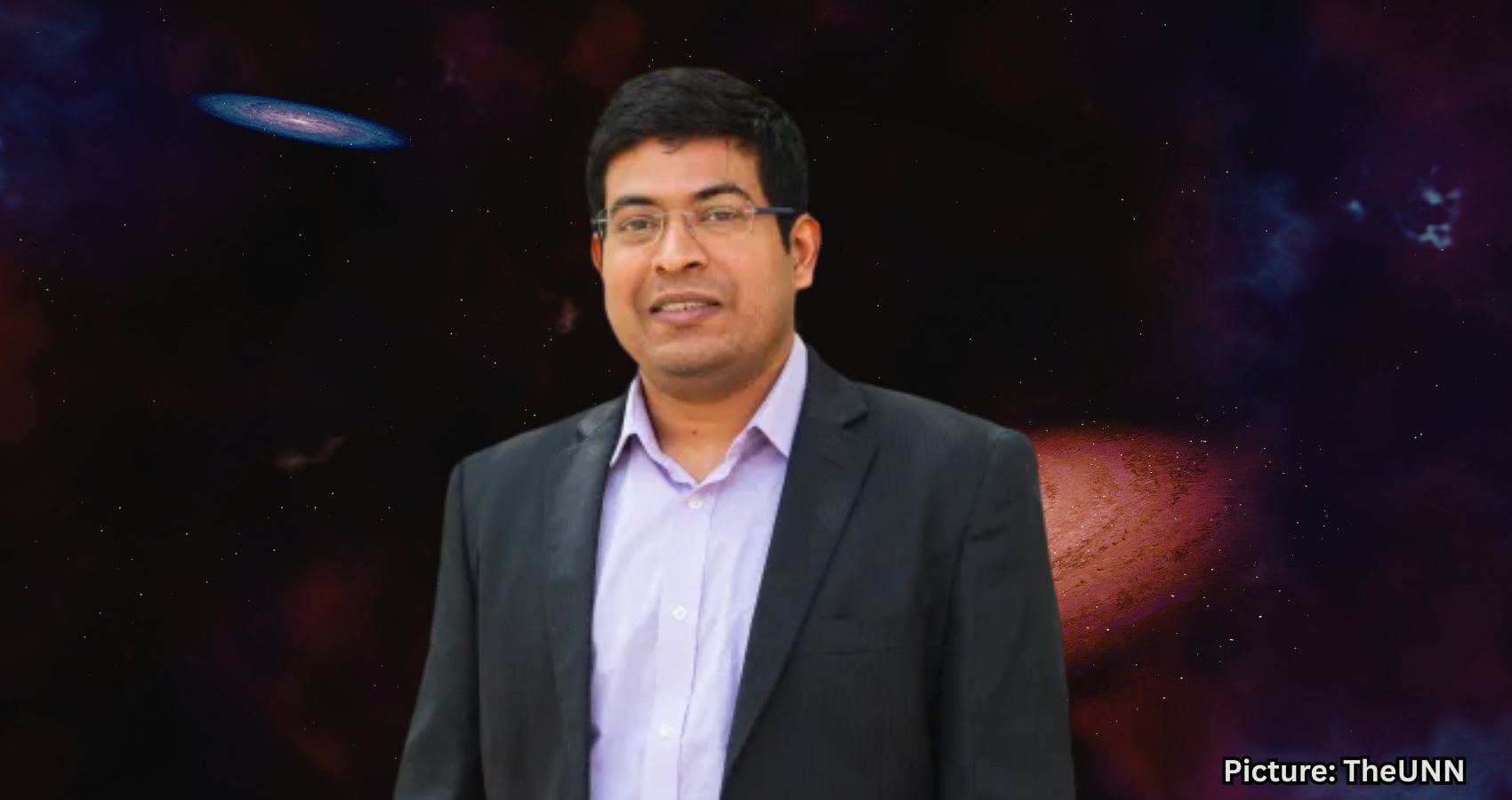
Indian American physicist Bhupal Dev proposes a novel explanation for the Universe’s evolution, suggesting that dark radiation may be misidentified as neutrinos.
A groundbreaking study led by Indian American researcher Bhupal Dev at Washington University in St. Louis presents a fresh perspective on the evolution of the Universe, addressing some of its most perplexing observations.
Dev, an associate professor of physics in the Arts & Sciences and a fellow at the McDonnell Center for the Space Sciences, posits that neutrinos—subatomic particles known for their elusive nature—might have transformed into a previously unidentified form of radiation during the Universe’s formative moments.
Neutrinos are among the most abundant particles in the cosmos, often described as ghostlike due to their weak interactions with matter. They play a crucial role in the formation and evolution of cosmic structures.
Recent analyses of cosmological data indicate that neutrinos may interact with one another more strongly than the Standard Model of particle physics predicts. However, laboratory experiments have imposed strict limits on such interactions.
Dev’s research offers a potential explanation for this discrepancy. The study suggests that signals interpreted as evidence of strongly interacting neutrinos could actually stem from an additional component of radiation present in the early Universe.
“Because cosmological observations mainly measure the total amount of fast-moving radiation, they cannot easily distinguish neutrinos from other lightweight particles that behave similarly,” Dev explained.
He theorizes that a portion of neutrinos may have converted into a different type of light, fast-moving radiation known as dark radiation shortly after the Big Bang nucleosynthesis, but before the formation of the cosmic microwave background.
“In this scenario, dark radiation could mimic the cosmological effects attributed to interacting neutrinos while avoiding the experimental constraints that apply to neutrinos themselves,” Dev noted.
If this dark radiation mechanism indeed occurred, it could address several ongoing puzzles in cosmology, including uncertainties surrounding neutrino masses and the long-standing Hubble tension—the discrepancy between various measurements of the Universe’s expansion rate.
“Our work highlights a broader paradigm in neutrino cosmology,” Dev stated. “The degeneracy between neutrinos and neutrino-like dark radiation opens up new avenues for addressing cosmological tensions while respecting terrestrial constraints.”
Future observations may provide the means to test this hypothesis. Next-generation measurements of the cosmic microwave background, large-scale structure surveys, and emerging 21-centimeter cosmology experiments could potentially unveil signatures of this hidden radiation.
Laboratory experiments designed to measure the absolute mass of neutrinos or to search for possible sterile neutrinos may also yield important insights. In essence, while the interactions between neutrinos and dark radiation may initially appear ghostly, they may not remain concealed indefinitely.
According to a university release, the findings of this study have been published in the journal Physical Review Letters.