
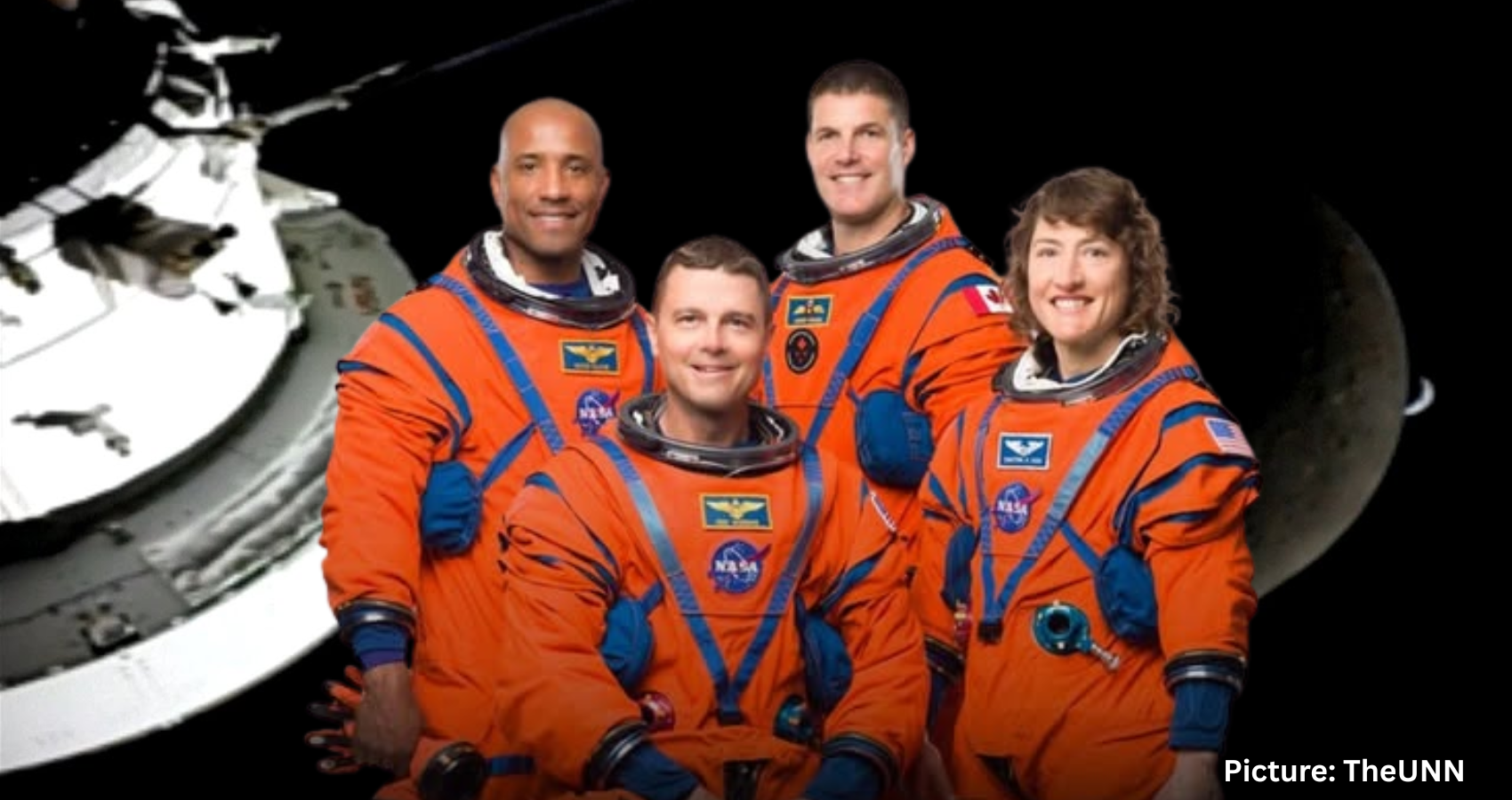
The Artemis II crew experienced a historic 40-minute communication blackout as they passed behind the Moon, marking a significant milestone in deep space exploration.
The Artemis II crew officially entered a communications blackout on Monday evening as their spacecraft moved behind the Moon’s far side, setting new distance records in the process. This unprecedented moment began at approximately 6:44 p.m. ET, during which the astronauts—Reid Wiseman, Victor Glover, Christina Koch, and Canadian astronaut Jeremy Hansen—became the most isolated humans in deep space history.
The blackout occurred as the spacecraft lost line of sight to Earth, with the Moon obstructing satellite communications entirely. Contact is anticipated to resume around 7:25 p.m. ET, coinciding with a moment known as “Earthrise,” when Earth reappears over the Moon’s horizon.
NASA has assured that there are no specific dangers anticipated during this mission, although ground control is prepared for potential contingencies. The astronauts have practiced essential tasks, such as consuming protein shakes and administering medication, while wearing their bulky orange launch and entry suits. This preparation is crucial in case they need to remain in their gear for an extended period.
In addition to the communication blackout, the Artemis II crew will achieve several significant milestones. At approximately 7:05 p.m. ET, the spacecraft is expected to reach its farthest point from Earth, at a distance of 252,760 miles. This surpasses the Apollo 13 record by roughly 4,105 miles, marking a notable achievement in space exploration.
At their closest approach, the Moon will appear about the size of a basketball held at arm’s length, according to NASA. Although ground control and the science evaluation room will not be able to communicate with the astronauts during this blackout period, the crew will continue to execute their lunar targeting plan and conduct scientific observations.
The astronauts are set to track historic Apollo sites, scout potential future landing zones, and capture rare views of nearby planets, including Mercury, Venus, Mars, and Saturn. They will also have the unique opportunity to observe a solar eclipse from the Orion spacecraft’s vantage point.
Earlier in the day, the crew broke a distance record previously held by Apollo 13, which was set in 1970. This achievement underscores the significance of the Artemis II mission as a pivotal step in humanity’s exploration of deep space.
According to NASA, the Artemis II mission is not only a remarkable technical achievement but also a historic moment in the ongoing journey of human exploration beyond Earth.