
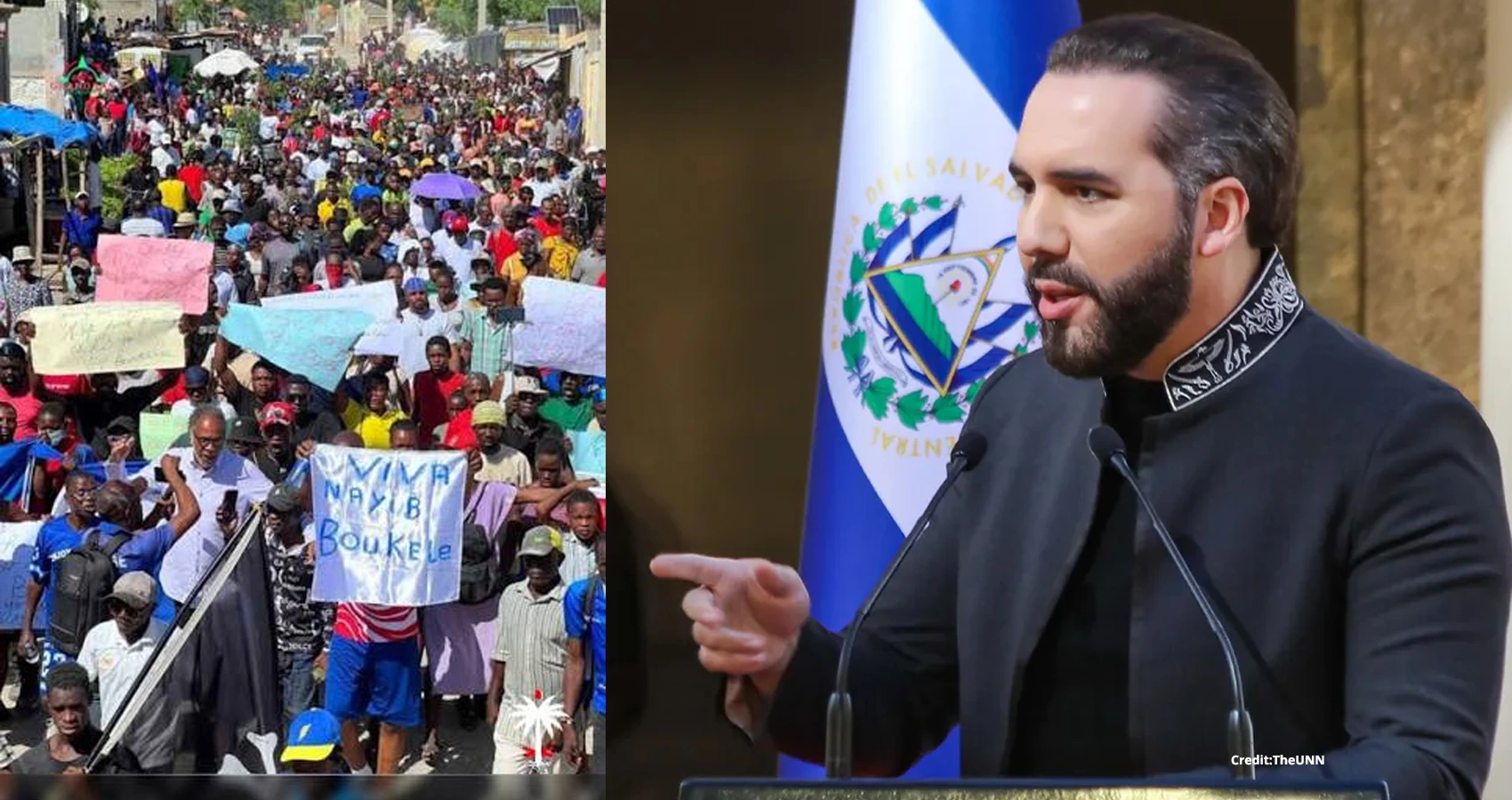
Thousands in Haiti rallied in support of Salvadoran President Nayib Bukele, expressing gratitude for his military intervention against violent gangs in the country.
Thousands of Haitians took to the streets on Tuesday to express their appreciation for Salvadoran President Nayib Bukele’s decision to deploy troops to combat violent armed gangs in Haiti. The demonstration coincided with Haiti’s Minister of Justice and Public Security, Patrick Pélissier, preparing for a trip to San Salvador to discuss anti-gang strategies and ongoing military cooperation.
In a heartfelt response, Bukele shared a video on social media platform X, capturing the vibrant scene of supporters chanting, dancing, and celebrating. “I never expected anything like this. I hear you loud and clear. I love you too. We will triumph. God will give us victory,” he stated.
Demonstrators carried signs proclaiming “Long live Bukele” and “Down with the gangs,” while many voiced their support for the Salvadoran leader. “Only a week of operation, we can see the path to change in Haiti. We say thank you to Bukele for all the help he gives us,” said demonstrator Claudy Mayas.
Another participant, identified as Claude, expressed the long-awaited need for security in Haiti. “Four years ago, I could not go to Champs de Mars. I couldn’t go to the south of Haiti. We don’t ask much of the government. We don’t ask for jobs. We need only security,” he remarked.
Just two weeks prior, Bukele supported a military operation that involved airstrikes targeting the headquarters of 400 Mawozo, one of Haiti’s most notorious criminal gangs. The operation also aimed at the home of the gang’s leader, Lanmò San Jou. This direct military action marked a significant escalation in Haiti’s ongoing struggle against rampant gang violence and insecurity.
Bukele’s involvement in the mission followed the disappearance of four Salvadoran members of the U.N.-backed anti-gang force, who were believed to have fallen victim to a gang ambush near Port-au-Prince on October 18. In response, Bukele dispatched over 2,000 troops to Haiti.
As residents celebrated in the streets, U.N. officials issued a statement emphasizing the importance of prioritizing civilian protection during anti-gang operations. “Security forces must strictly limit the use of lethal force to situations where it is unavoidable to protect life from an imminent threat and as a last resort,” the agency stated.
According to U.N. estimates, armed gangs control approximately 80% to 90% of Haiti’s capital and are expanding their influence into surrounding regions. Between January and October 2026, the U.N. documented nearly 4,600 fatalities, alongside the displacement of nearly 1.5 million people.
This outpouring of support for Bukele in Haiti reflects a growing desire among residents for stability and security in a country plagued by violence and lawlessness.
As the situation continues to evolve, the international community watches closely, hoping for a resolution that prioritizes the safety and well-being of the Haitian people. The ongoing collaboration between Haiti and El Salvador may serve as a pivotal moment in the fight against gang violence in the region, according to Reuters.